Premise & pre-planning
In this unit, I have been given three random words to base my game on.
Key word 1
My first word is ‘makeshift’.
The Cambridge Dictionary definition of makeshift is “temporary and of low quality, but used because of a sudden need.”
Since this project is very open to interpretation, I have the option to use this definition as a base or to come up with my own interpretation.
A lot of different ideas spring to mind when I think of this word. One idea is a hand-crafted world stitched together with everyday materials, which is close in theme to something like Paper Mario or Yoshi’s Woolly World, for example. Another interpretation revolves around shabbily-crafted props. Weapons, armour, housing, etc. A good example of this interpretation is the Fallout franchise. This theme could also apply in a more metaphorical sense. My story could revolve around someone who struggles with life and everyday tasks, as an example.
Key word 1 mind map
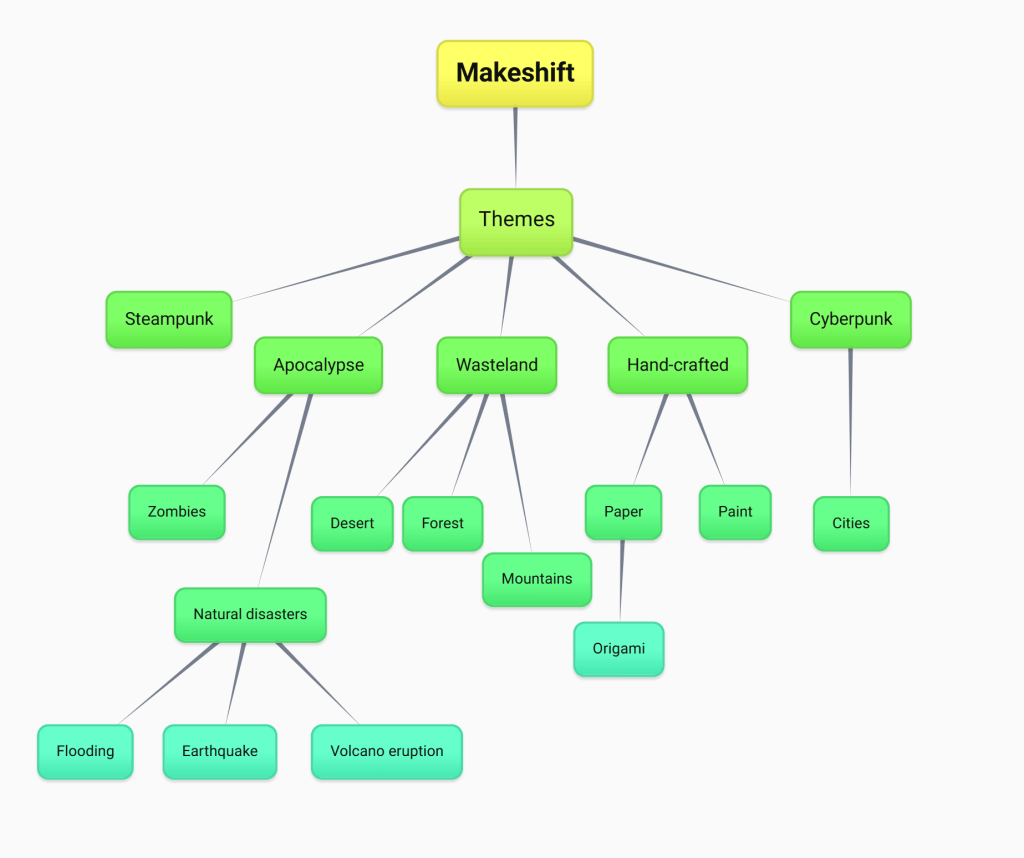
Above is my mind map for ‘makeshift’. I have come up with various themes that match my interpretation.
While some of these themes may not completely fit my interpretation, or they are simply too much work, I still think it’s good to get a good range of ideas.
With regards to natural disasters, I think it would be cool to utilise the volcano eruption.
Key word 1 colour palettes
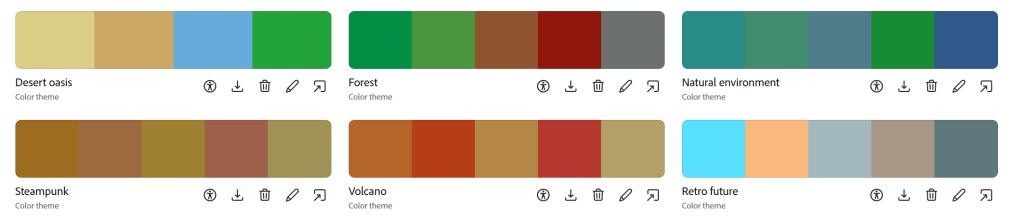
A few colour palettes which could potentially be used for inspiration.
Key word 1 research
I would like to first focus on the volcanic eruption idea from the mind map. Even though I may or may not end up using this idea, I want to thoroughly research different routes in order to ascertain how my project should look.
In terms of how I would use this idea, my game would be set in a world that revolves around a volcano which erupted several years in the past. This resulted in a lot of destruction to the area.
A volcano’s eruption causes a lot of changes to the area, including reshaping the landscape, altering the atmosphere and challenging human communities. One of the most immediate physical effects of a volcanic eruption involves the spreading of volcanic ash, or tephra. This can accumulate rapidly. Even a relatively thin layer can cause catastrophic damage due to its weight on structures and how hazardous it is to humans and animals.
Other new geological features are also formed. This can include something like the cooling and solidification of lava to the formation of a caldera.
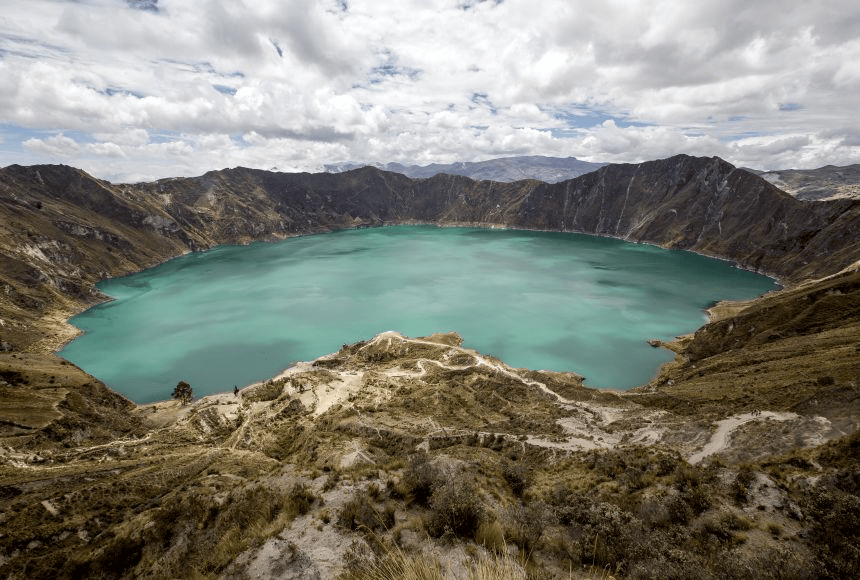
Without delving too deep into the scientific details, sulphur dioxide converts into sulphuric acid aerosols in the stratosphere. These particles reflect solar radiation, which leads to a short period of cooling on the earth’s surface. This typically lasts for one to three years.
Again, I may or may not end up using the volcano idea. The way they work is still interesting to me regardless.
Another potential avenue, as mentioned, is interpreting ‘makeshift’ in a more artful sense. I could base my art style on a hand-crafted aesthetic.
In terms of media I want to research, I might end up studying Fallout. Both the games and the TV series. This is because of its themes of survival and wasteland aesthetic, which links into my key word.
Key word 1 mood board 1
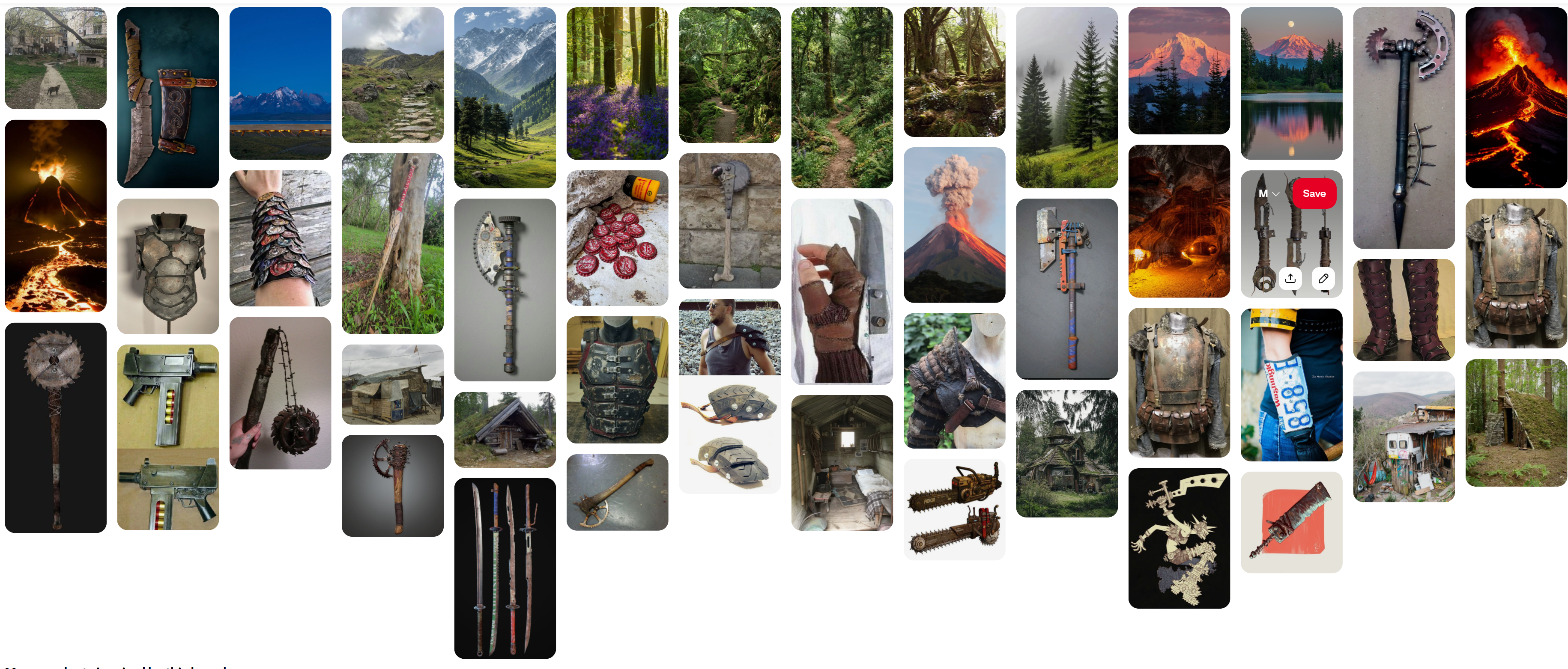
This mood board is a mismatch of my thoughts when I initially received my first key word. It consists of a lot of makeshift armour and weapons, alongside a few environments.
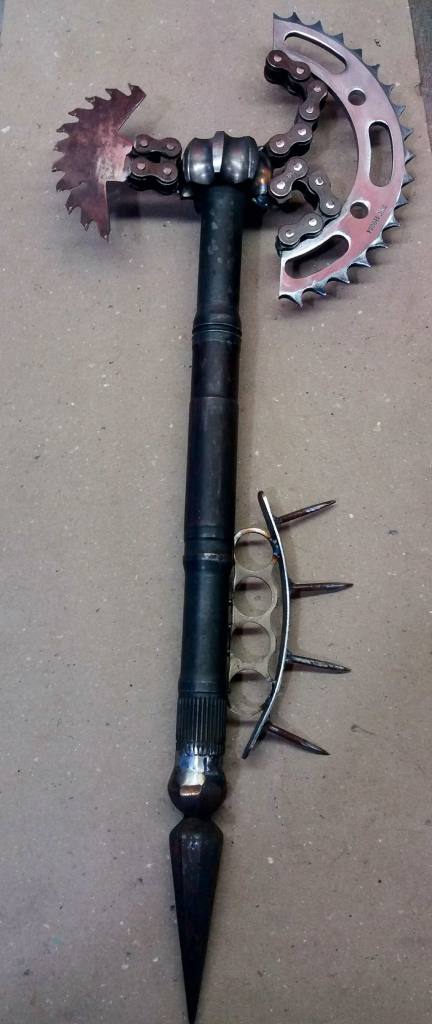
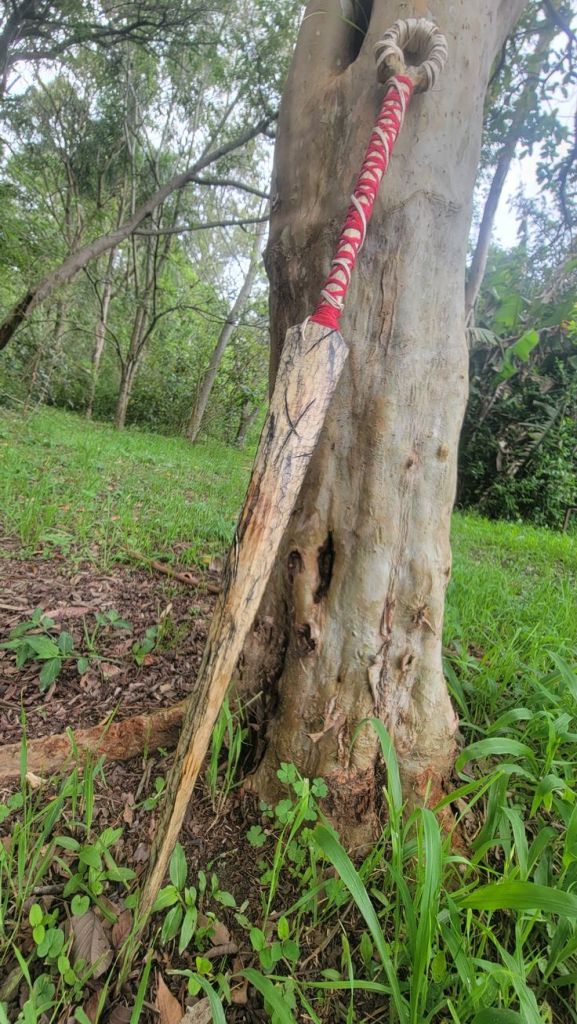
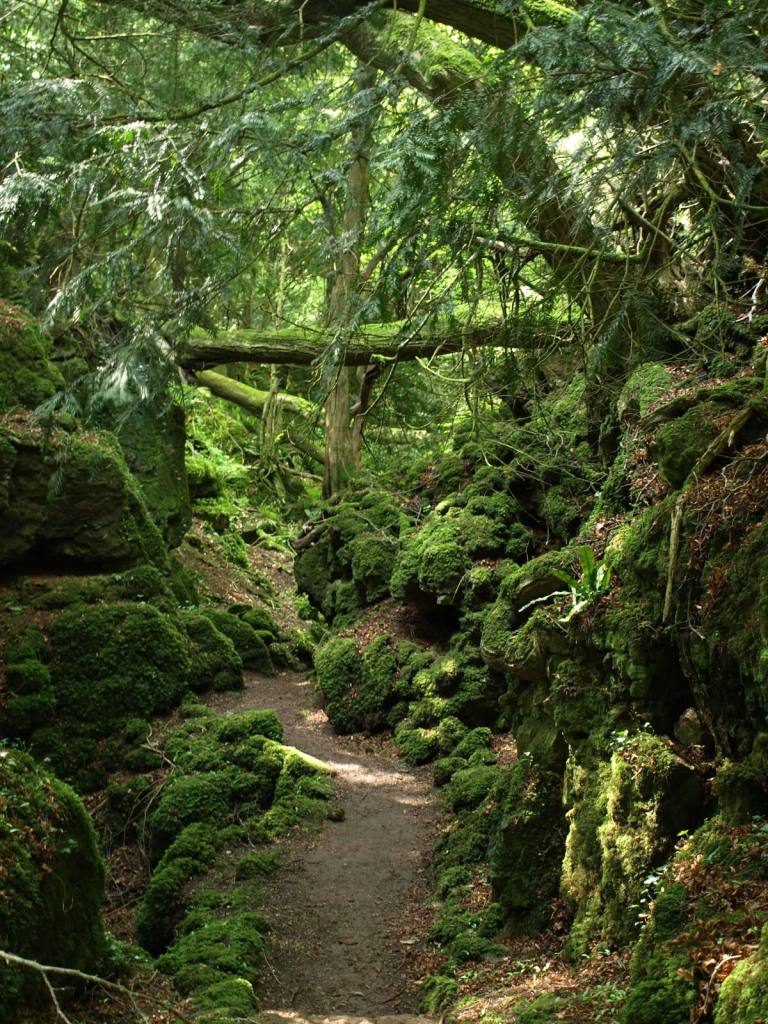
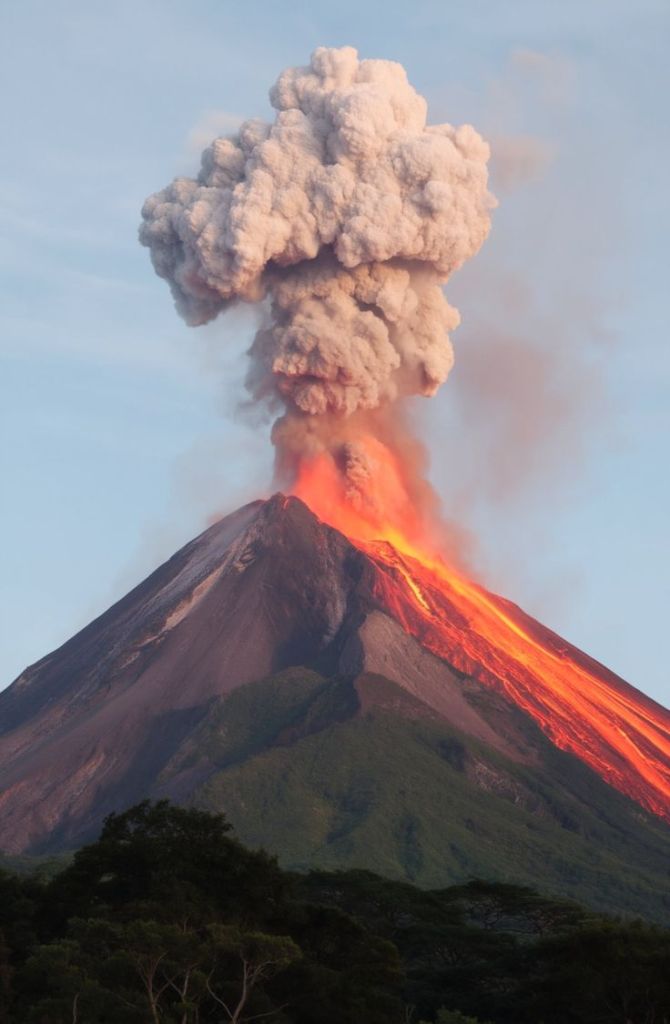
Above are some of my favourite images from this mood board.
Key word 1 mood board 2
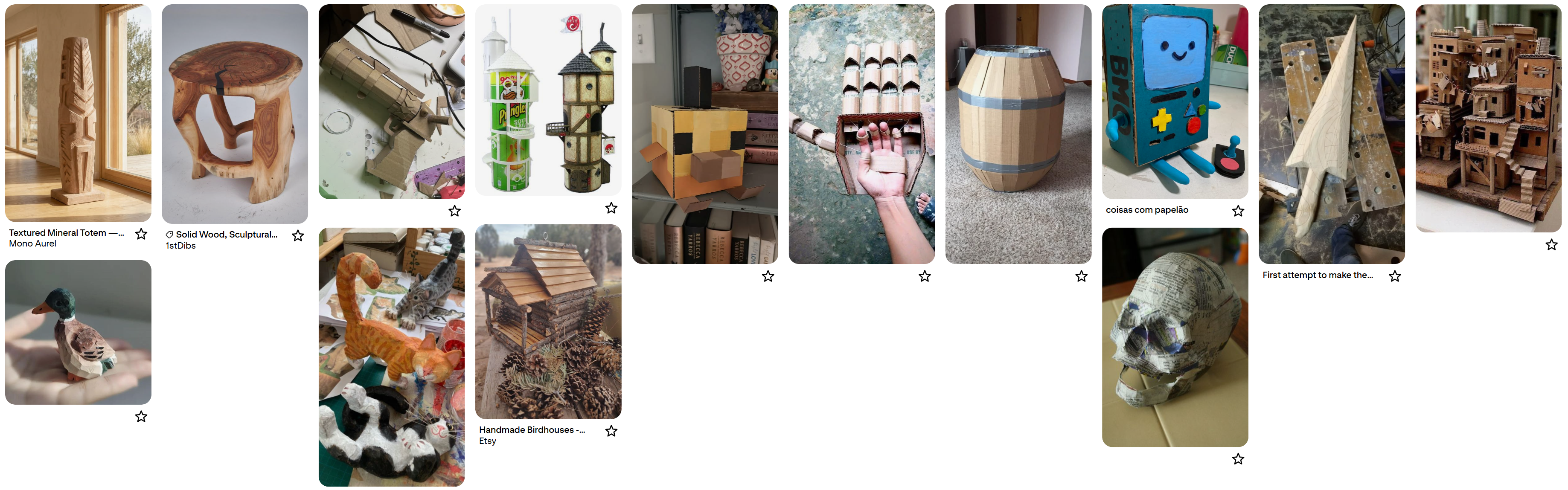
This mood board revolves more around the hand-crafted interpretation of ‘makeshift’. It features a few different styles, such as paper mâché, cardboard and woodwork. I find the pringles can tower quite funny.
Key word 2
My second word is ‘nostalgic’.
The Cambridge Dictionary definition of nostalgic is “feeling happy and also slightly sad about things that happened in the past.”
My personal interpretation of nostalgia revolves around my past. In particular, childhood. Things like childhood toys, pets and friends come to mind.
A few terms I would use to describe nostalgia include “fuzzy, bittersweet, familiar and homelike”.
Nostalgia can be triggered by a variety of different things. Even something like the surrounding environment or weather can be triggers. I personally get this a lot, particularly with wet/cold weather or places I used to visit a lot when I was a child. I could weave this into my project by utilising such weather effects and familiar environments.
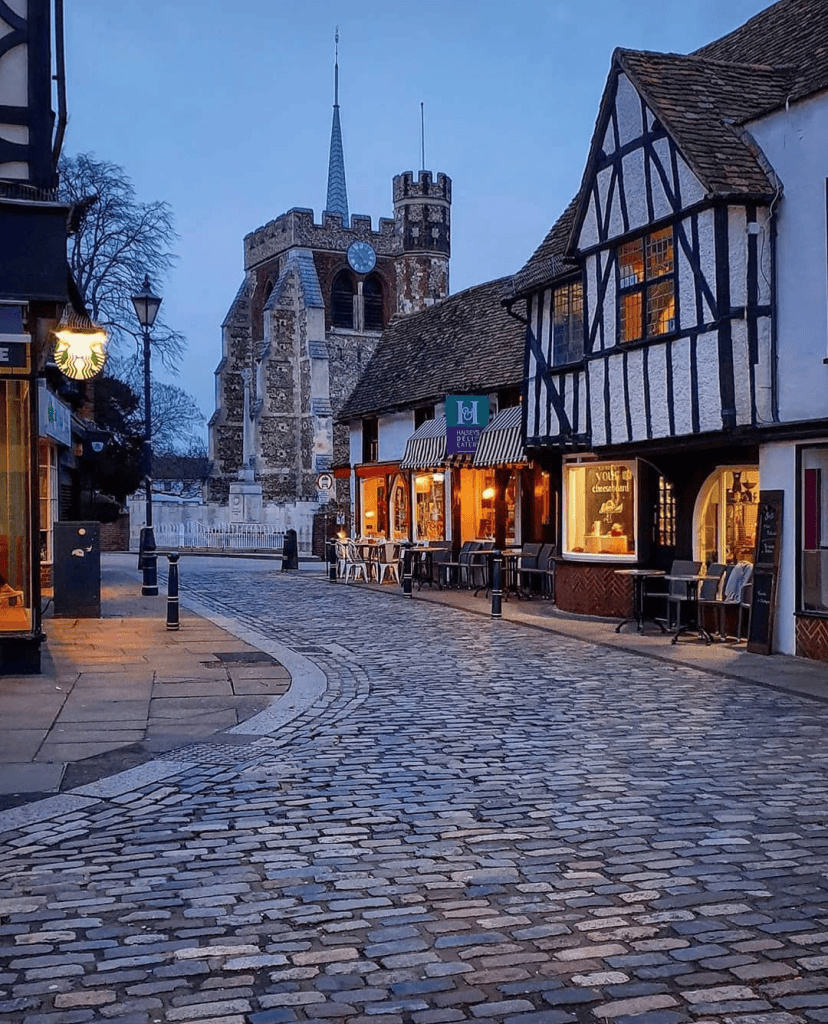
The above photograph was taken in Hertfordshire. I don’t believe I’ve visited this area before, but the image still gives off nostalgic vibes due to the similar architectural style like what I’m used to, alongside the early winters’ night. I love this vibe, by the way. Not only is it nostalgic, but very cosy too. I might be able to utilise this to my advantage.
Key word 2 mind map
Key word 2 colour palettes

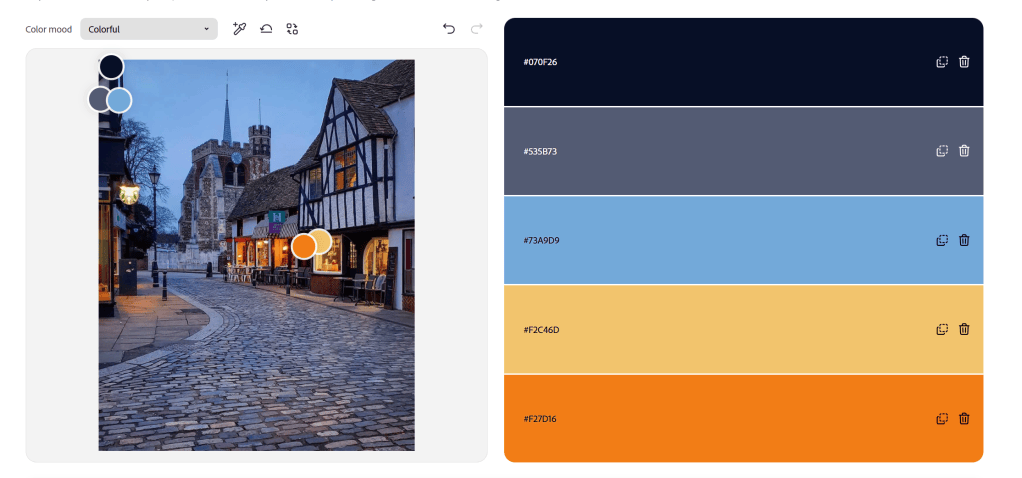
I have extracted the colour palette from one of my chosen nostalgic images using Adobe colour picker. Judging purely from how it looks to me, I believe it uses a complimentary colour scheme. I especially like this image because the majority of the space is used by cool colours. My eyes are immediately drawn towards the shop windows, which give off warmer temperatures. It all comes together to create a super cosy feeling, which also leans into my nostalgic theme.
Key word 2 research
A big aspect of nostalgia is a longing for the past and its characteristics. Its people, places, events and overall feel. It can provide a sense of home, belonging and comfort. It can lead to higher levels of empathy and social connection. But it can also be dangerous. It can warp the truth, making the past seem better than it was. In my experience, an overreliance on nostalgia can make it harder to appreciate what you have in the present day. Focusing on the past is important, but we should utilise it to improve our future. Not just daydream about the glory days.
Nostalgia can come from many places. It differs from person-to-person, but it is often triggered by social/cultural phenomena such as; movies, TV shows, video games, music, books and events, to mention a few. It can also be triggered by the environment, weather, smell, taste and such.
I feel like it would be difficult to describe true nostalgia to someone who has not felt it before. But I’m sure most people have experienced it to some degree. It’s one of those things that we just inherently know.
I could utilize these philosophical themes to my advantage.
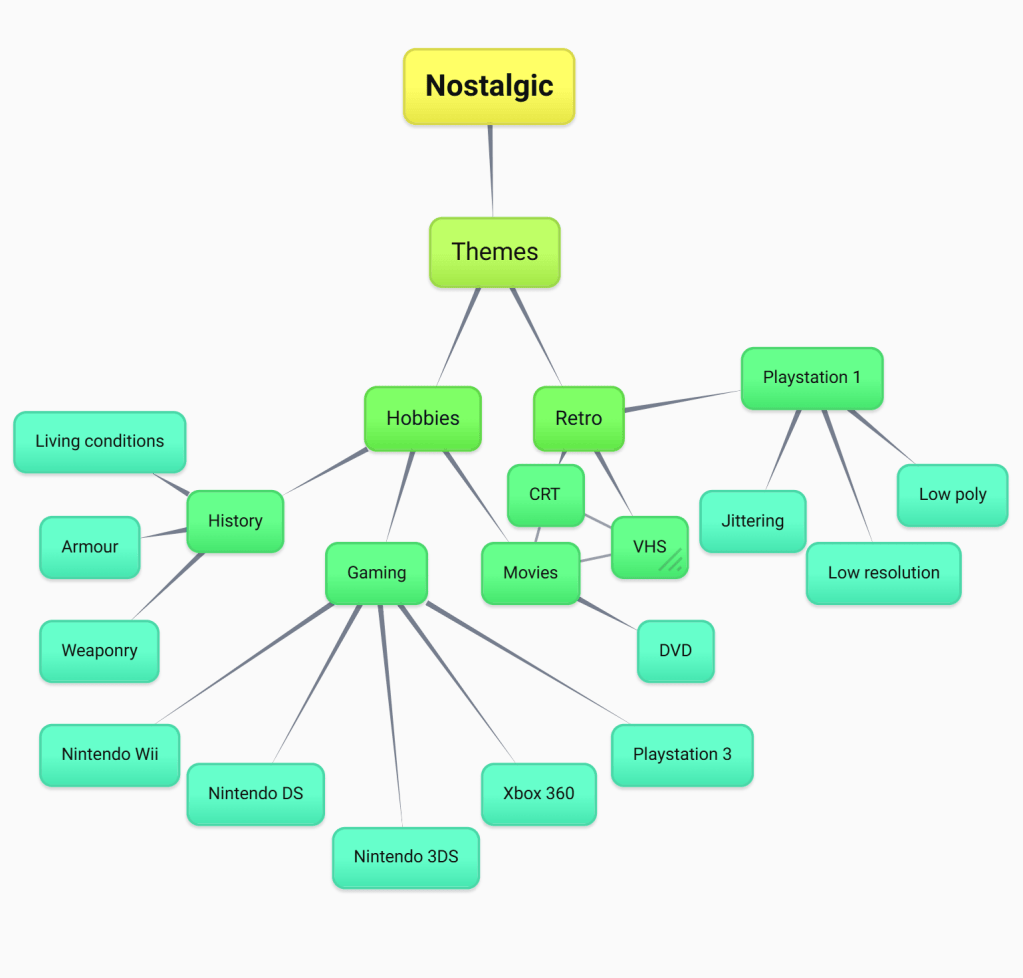
Nostalgia could also be utilised in a more literal sense. I could, for example, create a game with a retro-themed art style. Something along the lines of a low poly PS1 game. This would also have the advantage of making asset creation easier and quicker as I would not need to create a large amount of high-fidelity models.
In terms of media I could research for ‘nostalgic’, it is a bit tricky as it could apply to nearly anything which is either set in the past or released more than, say, four or five years ago. Ergo, the pool of films, games, books, etc. is functionally endless for this key word. Do I focus in on something specific to me? Or something a slightly older generation may like?
In the end, I decided to do a mix of both. I want to focus on some media which is nostalgic to me specifically, whilst also expanding my horizons and watching a few older titles. A few potential ‘nostalgic’ titles ‘ include: Star Wars: The Phantom Menace, Indiana Jones: Raiders of the Lost Ark and Back to the Future.
On the surface, it may seem like most of these films don’t have much to do with the nostalgic theme. But I want to dig a bit deeper. I want to study specifically how they compare to films today. Especially the films that have modern sequels which tend to be universally hated among fans and critics.
In addition, I would like to talk about another other phenomena. Anemoia is the nostalgia for a moment that occurred outside of one’s memory, or not at all. In other words, one may feel nostalgia from something they never experienced. For example, someone born in the 2000’s might feel nostalgic when looking at photographs and videos from the 1990’s.
This phenomena intrigues me. On the surface, it would make little sense. People typically associate nostalgia with older generations, and yet, more and more young people in their teens and early adulthood are reminiscing about simpler times. Could it be because of how rapidly the world is changing? Things like social media make it difficult to cross the bridge between memories and the present when all these memories are a click or a swipe away. Olivia Szinetar, a health psychologist and founding partner of the Sens Psychological Care Centre in Madrid states the following:
“The most recent generations have a more present past, an excess of photos and memories that obstruct the experience of loss. We are in the age of immediacy; everything is one click away. Nostalgia has become a resistance to accepting loss. Those who live in nostalgia resist reality.”
I’m inclined to agree. Nostalgia is like a drug, to an extent. Too much reliance on it as a crutch can lead to the aforementioned effects.
So why do these younger generations tend to romanticise a past they never got to experience? There is a widespread belief that most generations have had better lives than their parents. This is less true for our generation, generally speaking. This is because of things like job insecurity, ridiculous housing prices, lack of interest in starting families and so on.
Key word 2 mood board 1
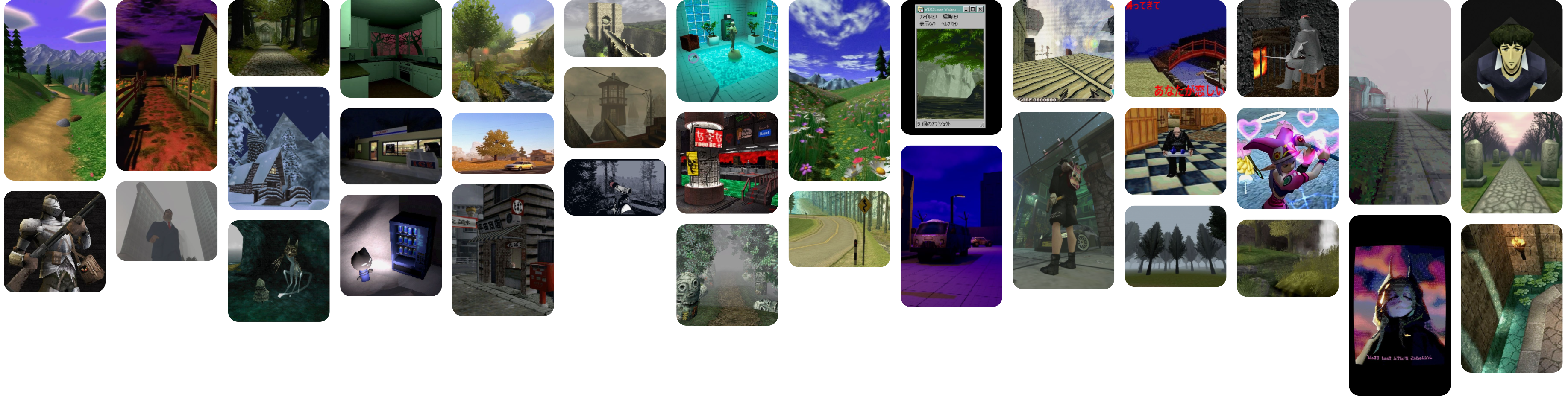
Above is my Pinterest mood board which is based on early 3D video game graphics. I focused on the PS1 and PS2 aesthetics here.
Below are a few of my favourite images from this mood board.
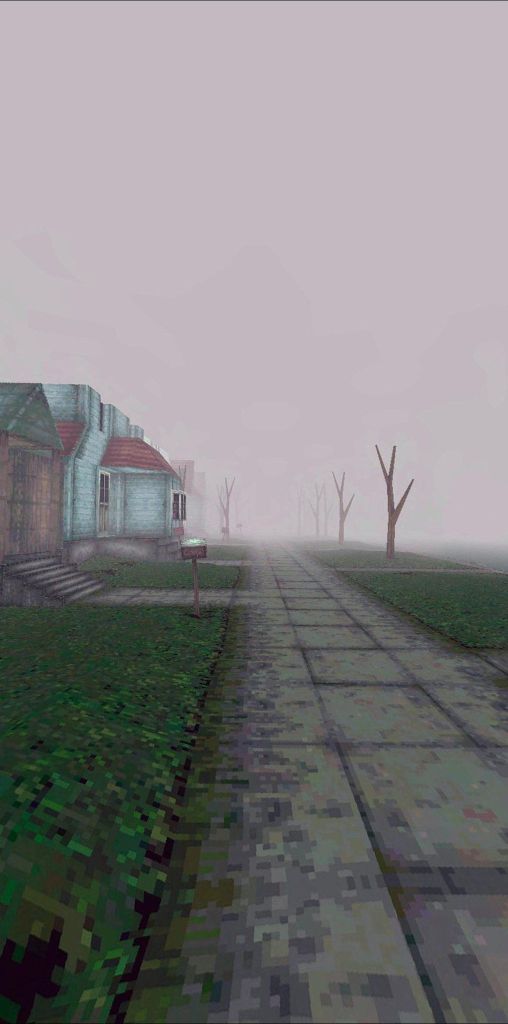
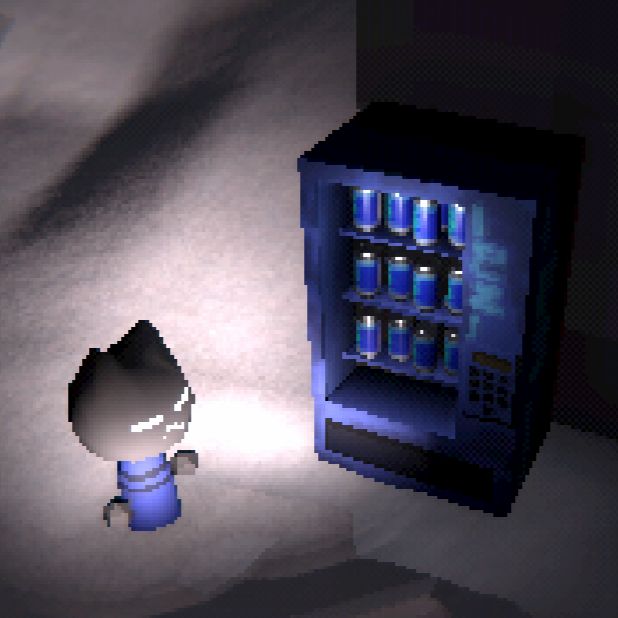
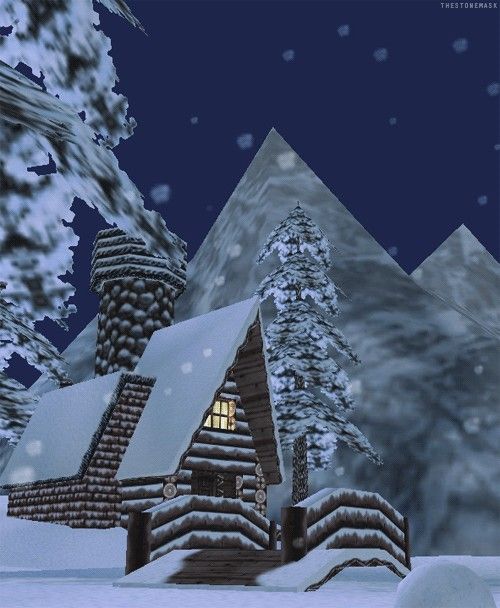
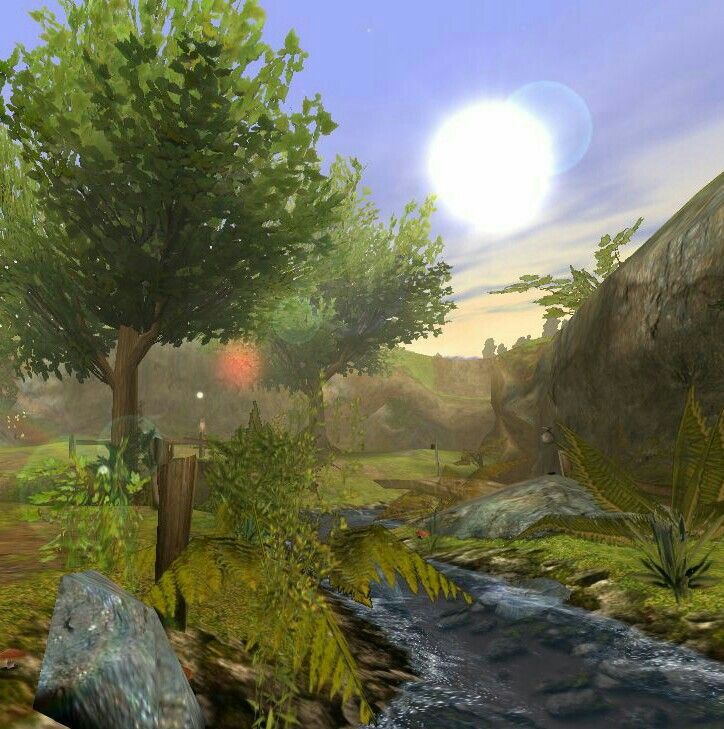
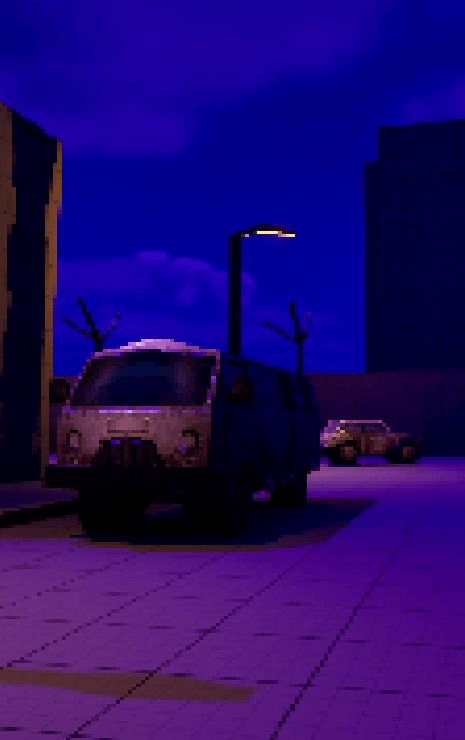
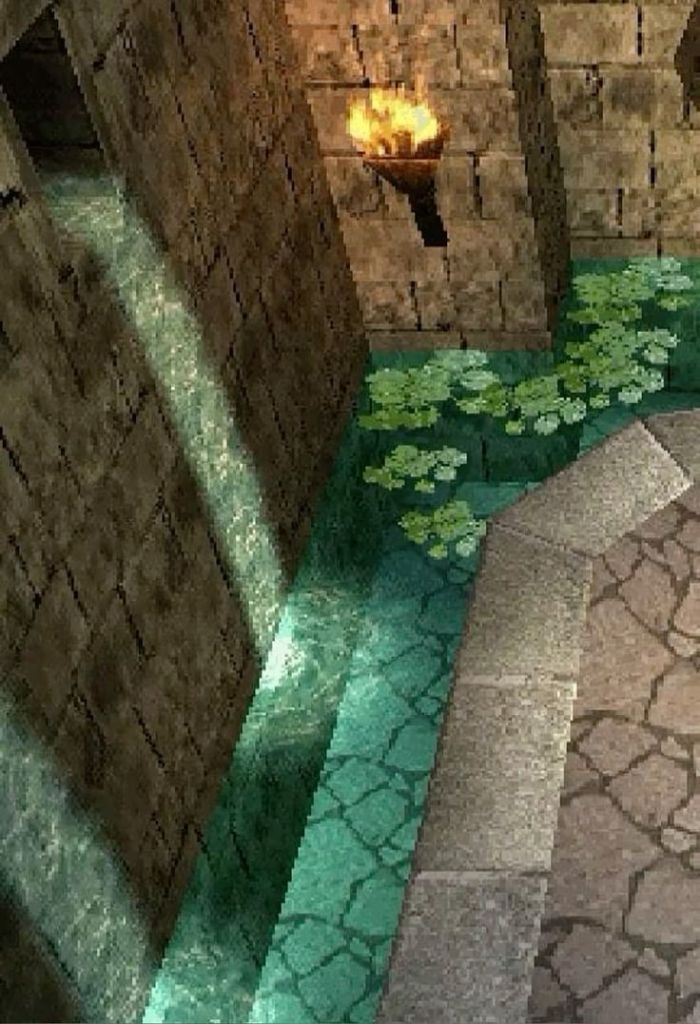
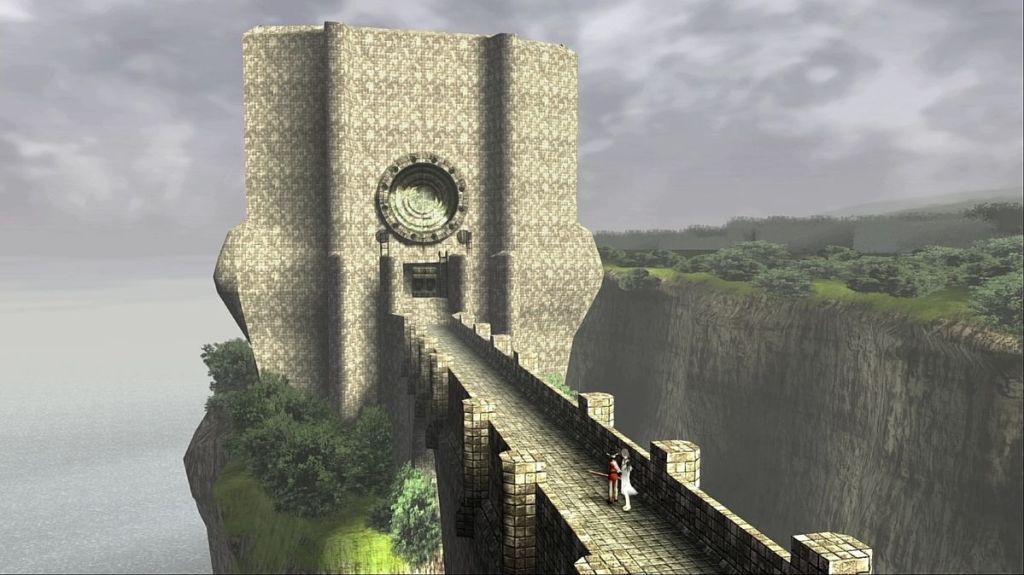
These images invoke all the aforementioned feelings associated with nostalgia. Some of these are from actual games, too.
Key word 2 mood board 2
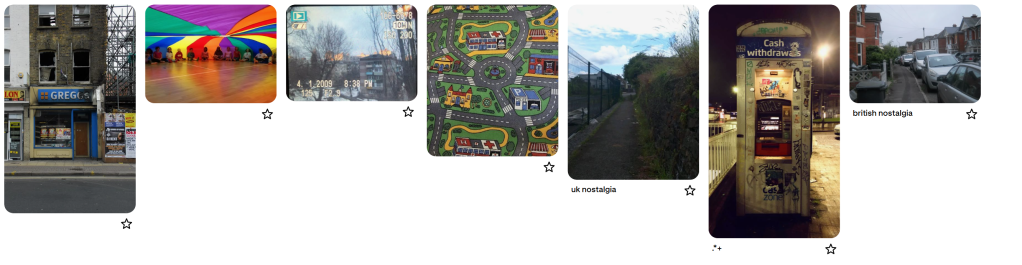
My second mood board for nostalgic revolves around UK nostalgia specifically. I could use some of these props, such as a telephone box, in my final game.
Key word 3
My third word is ‘eerie’.
The Cambridge Dictionary definition of eerie is “strange in a frightening and mysterious way.”
I think the last two key words can go hand-in-hand with ‘eerie’ quite well. Especially in the case of ‘nostalgic’.
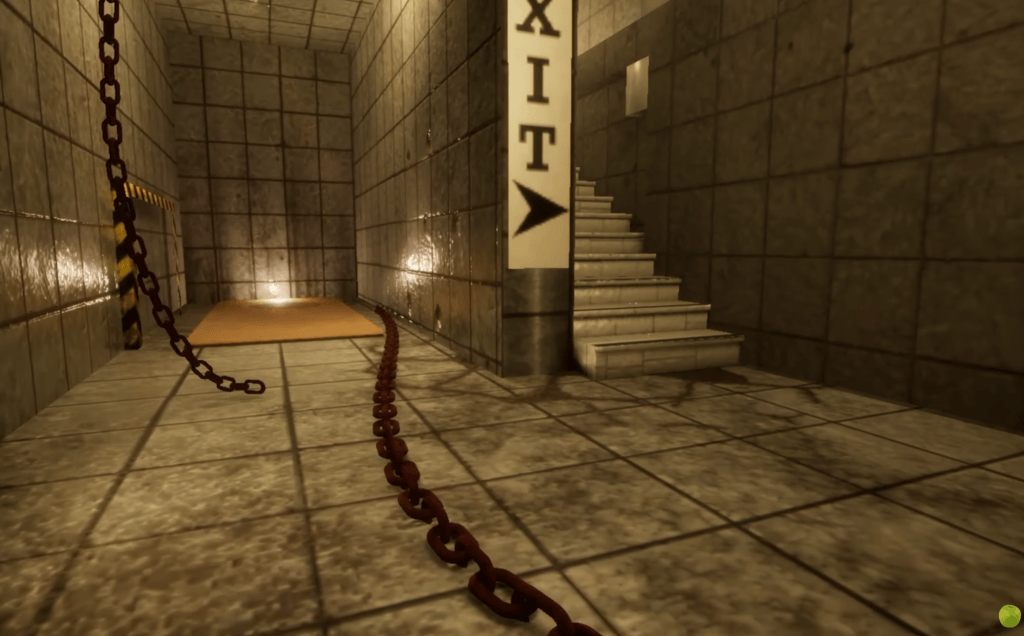
When I picture eerie imagery, my mind doesn’t default to something others may consider ‘creepy’ or ‘spooky’. I moreso associate it with a specific type of environment. Somewhere with moody lighting, fog (if the location is set outside) and most importantly, not another human being in sight. For example, a subway late at night or a forest may be good examples of this idea.
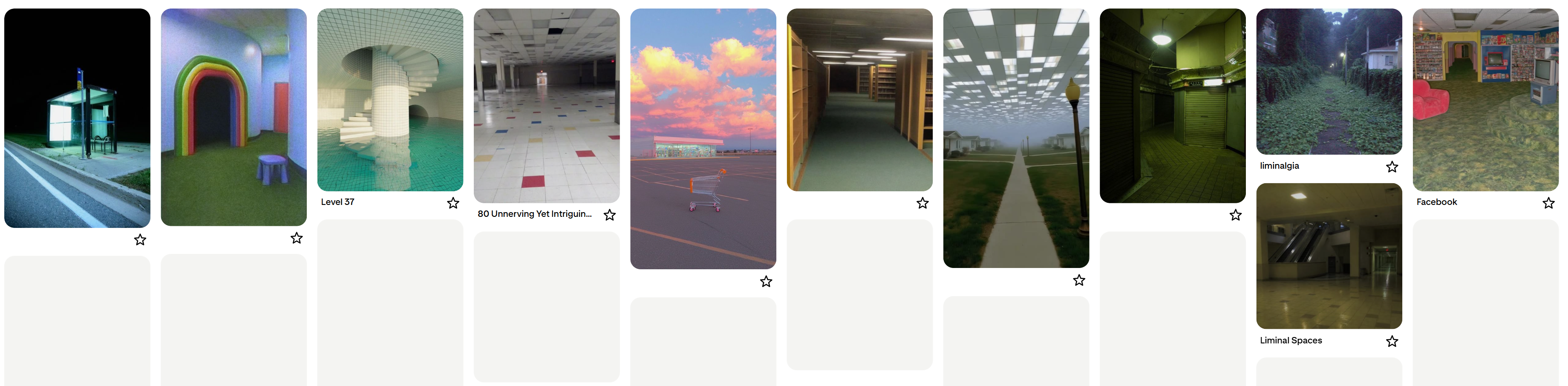
An amazing example of ‘eerie’ is the concept of liminal spaces. These are often centred on man-made environments which can evoke nostalgic or eerie vibes. This is achieved by the surreal and uncanny appearance of these places, and the lack of other people.
Key word 3 mood board 1
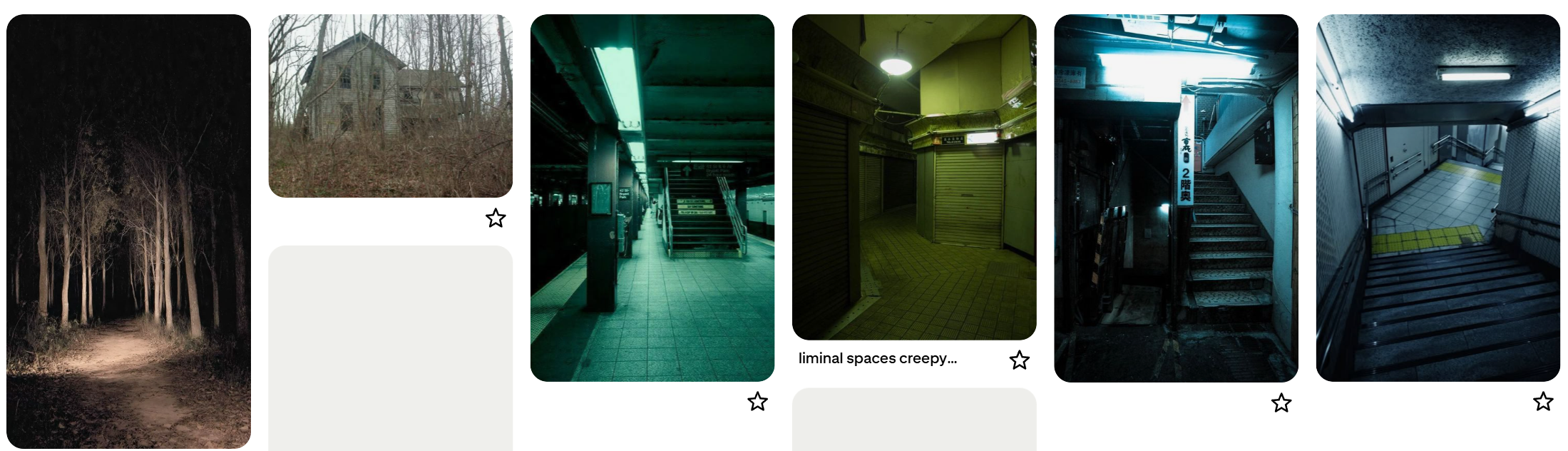
I believe the above mood board conveys my ideas about eerie imagery rather well. By the way, I used the image second from the right as inspiration for an area in my final major project last year. I likely won’t end up executing the subway idea, but it goes to show that I do have some experience creating a creepy environment.
Key word 3 colour palettes

I decided to do seasonal-themed colour palettes for my third key word because I feel like different seasons give off eerie vibes under certain circumstances. For example, a winter or autumn night may convey eerie or creepy vibes. A spring morning may also feel slightly eerie, due to natural phenomena such as dense fog, early sunrise, etc.
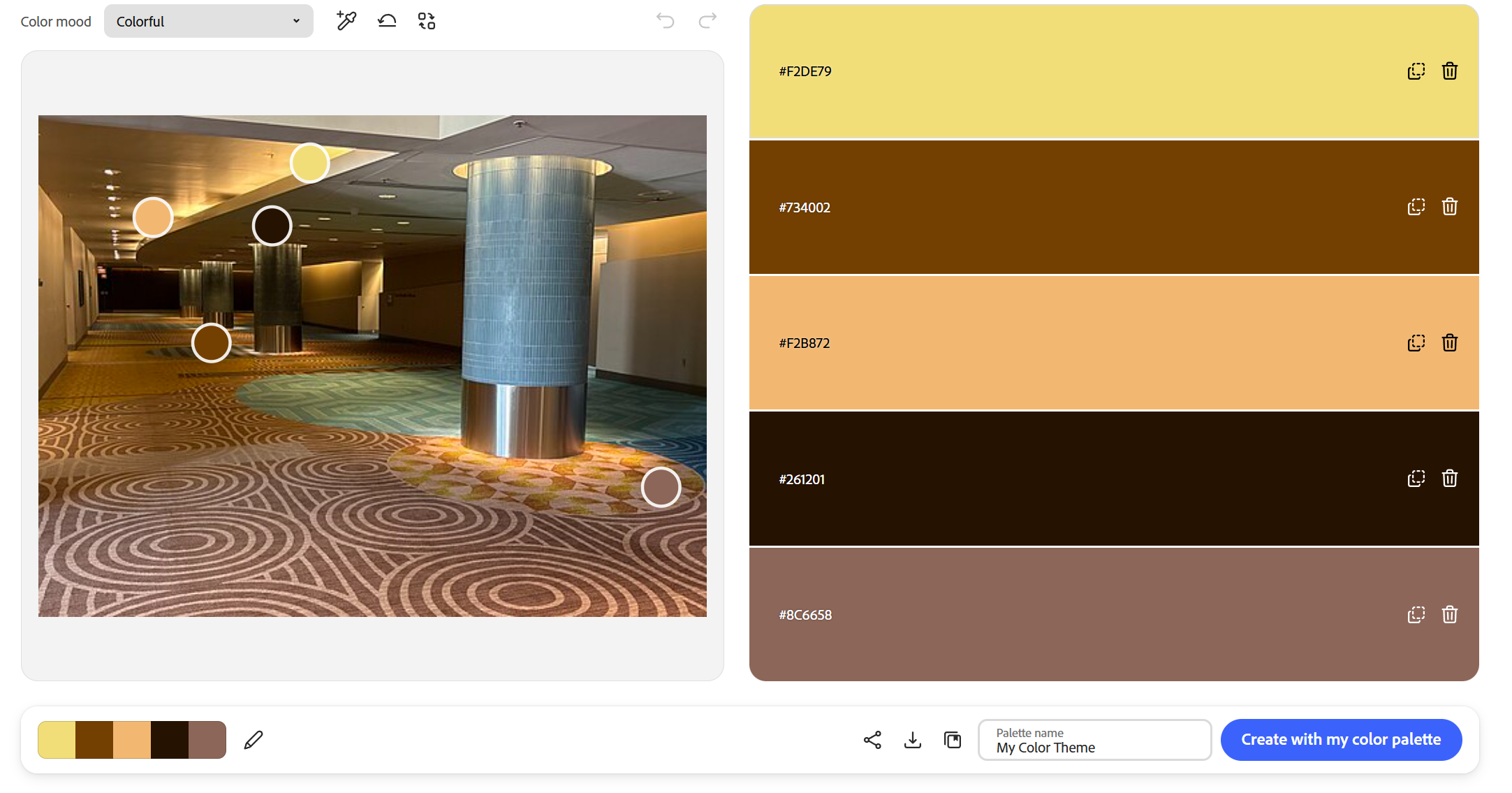
Above is a colour palette of a liminal space.
Key word 3 mood board 2
Key word 3 research
‘Eerie’ can be interpreted in many different ways. For my research on ‘eerie’, I am going to try experiencing various different types of media which relate to this term. In particular, I want to focus on horror, or horror-adjacent genres. This is because I feel like ‘eerie’ and horror go hand-in-hand.
Additionally, I have found a good thread on Reddit which recommends a few films specifically centred around being eerie. A few of these recommendations include It Follows, Under The Skin, A Dark Song and The Invitation.
In terms of recommendations, I have also found a good list on Rotten Tomatoes which details their top 200 horror films of all time. There is also a list on IMDB which specifically details 15 eerie films. I will pick out a few from these lists and watch them in order to gain some inspiration for my project.
Research – films & TV
Watchlist:
- Psycho (1960)
- The Exorcist (1973)
- Star Wars: The Phantom Menace (1999)
- Indiana Jones and the Raiders of the Lost Ark (1981)
- Back to the Future (1985)
- Fallout (2024)
- Resident Evil (2026)
The above watchlist contains titles which to relate to one or more of my key words. I may or may not get through all of these, especially Fallout as it is an episodic TV show. I would at least like to start the rest of the list.
Resident Evil (2026)
A few nights ago, as of writing, I went to the cinema to see the Resident Evil film. This movie fits into my ‘eerie’ criteria, and even ‘nostalgic’ to a certain extent. As it is in the horror genre, it naturally features a lot of unsettling imagery. The entirety of the film takes place during the night-time, which naturally leads to a lot of dimly-lit scenes, reinforcing the eerie/horror theme. I could use this for inspiration. I might set the name during the night, have a lot of dimly-lit areas, or both. Additionally, a good chunk of the early film takes place in the snow, which, again, relates back to nostalgia and reinforces the eerie feeling. Spoiler warning for those who haven’t seen the film, but it also plays slightly with the idea of parenthood. During the events of the film, the main character’s significant other is pregnant with their child. At the start of the movie, the main character explains that he may not feel ready for children yet. Later on, in an emotional scene, he leaves a voice note for his partner telling her that he has changed his mind and wants to keep the child. Notably, this is the last time that the protagonist gets to communicate with her. This is due to the fact that, earlier on in the film, he was bitten by an infected child and is beginning to transform. By the way, I would like to quickly point out how the protagonist shot the infected child after she bit him. I think the film glosses over this point, but I like to imagine this had a severe effect on the protagonist’s mental state and is what changed his mind about his partner’s pregnancy.
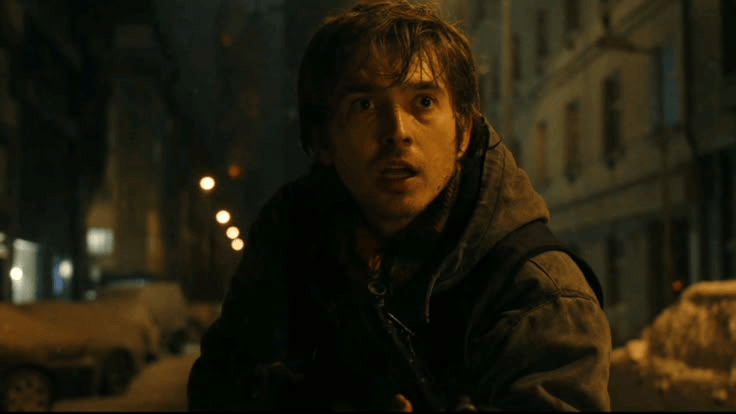
The reason I’m talking about these key plot points is because it relates to the idea of childhood and naturally ties into nostalgia. The film leans more into action/thriller horror, which isn’t what I’m going for. Still, I think seeing this film provided me with some good ideas for how I could execute my game.
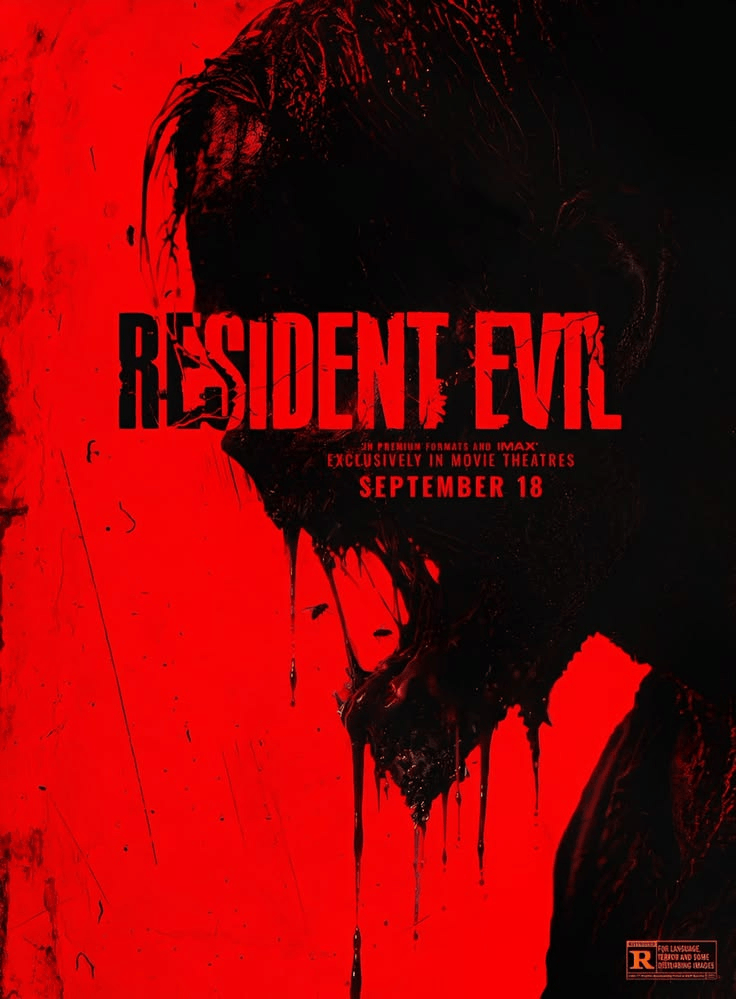
I love the poster for this film, too. In fact, I think a good chunk of the games’ posters or box art is great too. I think these works of art convey the sense of dread and horror that Resident Evil is about.
Research – games
There are a few games I would like to analyse here. First, I would like to play Easy Delivery Co. and analyse its art style and themes.
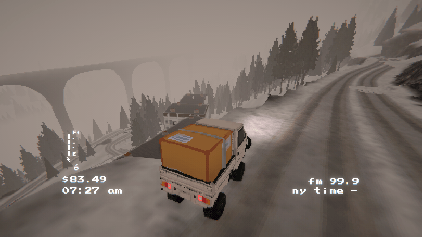
From what I can gather before playing, the game has a lot of aspects which are interesting to me. First and foremost, the art style. It is very nostalgic, as its style attempts — and succeeds, in my opinion — to mimic that of a PlayStation 1 game. It obviously isn’t going to be one-to-one, but it feels close enough for my liking.
Easy Delivery Co. revolves around the player, an anthropomorphic cat, delivering packages to residents of three different villages. The game has some lore and characters to unpack too, which is almost always appreciated. The game is rather short, at around 6 hours.
Up next, I would like to discuss a few retro titles. I have picked games from most of my favourite retro systems to talk about here. Unfortunately, I won’t be focusing on a few key systems I have less experience with.
There are a few key SNES titles I want to bring up. First, I’ll talk about Super Metroid. This is simply because it is the pick I have played most recently. A lot of people rate Super Metroid very highly. This is because of many different aspects. The open-ended exploration, the replayability, the addictive upgrade loop and the atmosphere all come together to make an unforgettable experience. I want to specifically talk about the atmosphere. In my mind, this is composed of five key aspects. Sound, level design, storytelling, visuals and oppressive gameplay. I’ll talk about oppressive gameplay first, as it’s likely the least self-explanatory. What I mean when I say this is that Samus, the player character, starts out extremely weak after her battle with Ridley, the main antagonist. All the player’s upgrades are lost. This creates a sense of oppression in the player’s mind. In fairness, as the player learns their way around the planet Zebes, this feeling might dwindle in their mind. Strong emphasis on the might. Even as the player unlocks new upgrades, the enemies grow stronger, encouraging further exploration of the world to unlock more health and missile upgrades. The bosses are also extremely difficult if the player is unprepared, which I was on my first playthrough. The oppressive gameplay overlaps with most of the other key aspects of Super Metroid’s atmosphere.
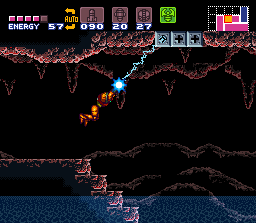
I want to quickly talk about the storytelling, or lack thereof. At least, in a direct fashion. The player gets exposition at the beginning and end, and that’s about it. However, when one digs deeper, there’s a lot there. The dark themes of loss and survival and the strong environmental storytelling elevate the experience. The sound design and visuals are both lovely, too. Even by today’s standards, the entire game holds up extremely well.
Super Metroid naturally went on to inspire many classics. Most notably, Castlevania: Symphony of the night, Hollow Knight and Hollow Knight: Silksong, MiO, Ori and the blind forest, Guacamelee!, the rest of the Metroid franchise and the list goes on. These games all fall under the ‘metroidvania’ genre. This is not the approach I am looking for in my game. However, there are aspects of these games that inspire me. The atmosphere, the subtle storytelling, the carefully crafted levels and the sense of dread and/or wonder some of these games inspire.
I would like to discuss the Zelda series too. In particular, the 3D entries. I’d like to start with Breath of the Wild Many praised the game for its outstanding world design and attention to detail, while others criticised the low weapon durability, lack of traditional Zelda elements and its lacklustre story. Even as someone who staunchly defends these aspects of the game, I can see why so many threw these criticisms around.
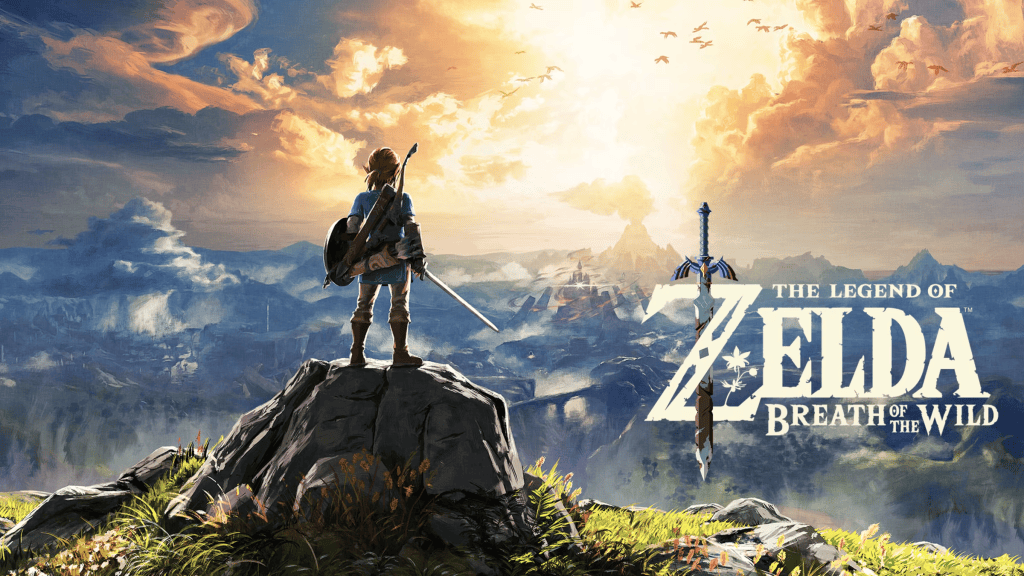
There is no denying that Breath of the Wild was a massive departure from what fans were used to with 3D Zelda. In my opinion, it was a much-needed refresh for the series and succeeded extremely well. However, its sequel, Tears of the Kingdom, refused to fix a lot of what fans disliked about the previous entry. In fact, it doubled down on them. The narrative was even weaker, weapon durability was back and arguably even more egregious than before and the newly introduced dungeons, sky islands and depths felt under-utilised. There were also a few other smaller flaws which added up to make the game more annoying to play at certain points. I can personally defend the dungeons and extended map, even if certain areas felt somewhat weak.
In spite of these controversial aspects from this duology, I firmly believe few games have mastered the sense of scale, wonder and exploration in an open-world setting as well as these two games. The world of Hyrule is exceptionally well-designed. One can really tell how much thought and care the environment designers and artists put into their work. The reason I bring this up is because if I can incorporate a level of attention to detail even half as well as the Zelda team, I will be happy. Obviously, my project will be vastly smaller in scale. I can use this to my advantage, however. Instead of focusing on creating a hundred different levels and environments, (because, let’s face it — it’s not doable for me) I can create three or four levels which are tightly-woven to convey my chosen words.
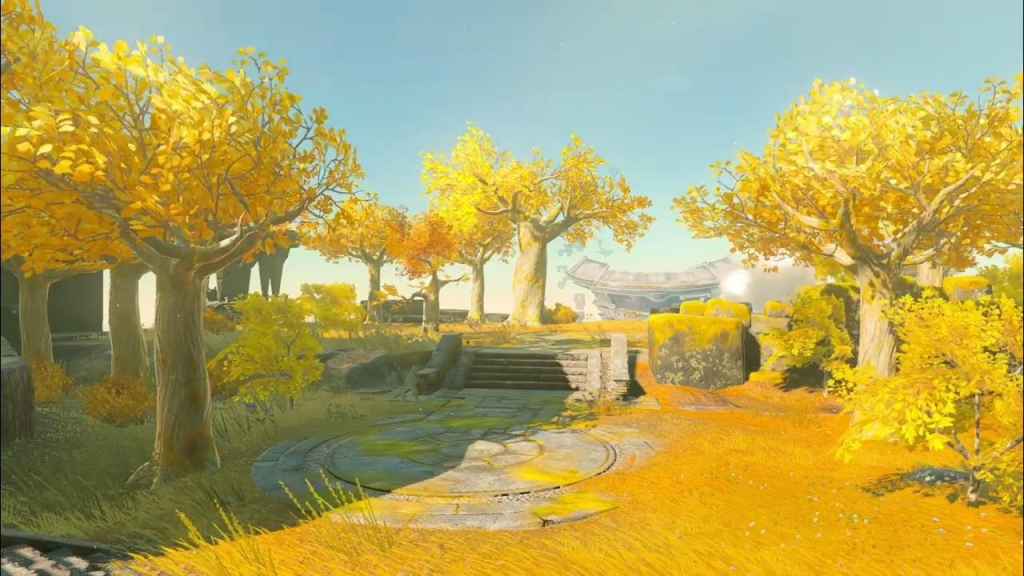
There is a lot I want to speak about in terms of 3D Zelda, especially since a few of the games fall under ‘eerie’ and ‘nostalgic’. In particular, Twilight Princess and Majora’s Mask, which, coincidentally, are my two favourite 3D Zelda games, master both of these aspects. In fairness, the nostalgic aspect is probably due to the fact Majora’s Mask and Twilight Princess are much older games. (26 and 19 respectively)
I would like to discuss Majora’s Mask first. It will be difficult to talk about this game without talking about Ocarina of Time — the previous title. Ocarina of Time revolves around Link, a young boy from Kokiri forest. The forest serves as Link’s hometown. After the first dungeon, the Great Deku tree, Link leaves for his grand quest to smite Ganondorf and save Hyrule. I like to think that this small step symbolises the beginning of Link’s journey in both a literal and metaphorical sense. He has begun his grand quest, but at the same time, he has lost a part of his childhood and innocence. This theme is further backed up when Link becomes an adult slightly later in the game and returns to a ruined Hyrule.
Link’s backstory is intentionally missing key details. All the player knows is that he is a war orphan and was left in the care of the Great Deku Tree. Ironically, this leads to Ocarina of Time being a profound tragedy about adulthood, growing up and losing your sense of innocence. This is all to say that Zelda has always had quite subtle and vague storytelling, which I like. I can strongly relate to these themes. In addition, they tie in well with my ‘nostaglic’ key word.
Ocarina of Time’s ending is equally as ambiguous. Link’s companion, Navi, who has accompanied Link since the beginning, flies away. Presumably never to see Link again. I like to think this ending symbolises the pain that comes with growing up and never again getting to see those whom you care about most. It’s something that looms in the back of my mind a lot. The feeling that, someday, you will inevitably speak to a close friend or loved one for the last time. Maybe without even knowing it. Our childhoods will fly by, whether we like it or not. The memories we make, however, last much longer. Some of us may rely on these memories for support, even if we don’t realise it. It’s completely natural. Our adult lives carry a lot of stress and responsibilities. Maybe we long for a feeling of home, cosiness or normality. I think this ending symbolises this, too. Link’s step into maturity and a reflection on his childhood.
Majora’s Mask backs up these ideas by toying with the idea of childlike innocence. The game starts out with Link riding his horse, Epona, through a mysterious-looking forest. He is shortly attacked by Skull Kid, who functions as an antagonist of sorts throughout the game. Different to Ganondorf, however, this creature is not driven by malice, hatred or a desire for power. He is simply a mischievous being who is looking to cause mayhem. In Zelda lore, Skull Kids are children who wander into the Lost Woods. Shortly after attacking Link, Skull Kid runs off with Epona. I should mention that Skull Kid is also under the influence of the titular Majora’s Mask. From here, Link chases after the Skull Kid, which leads him into falling down a massive hole which leads to the land of Termina.
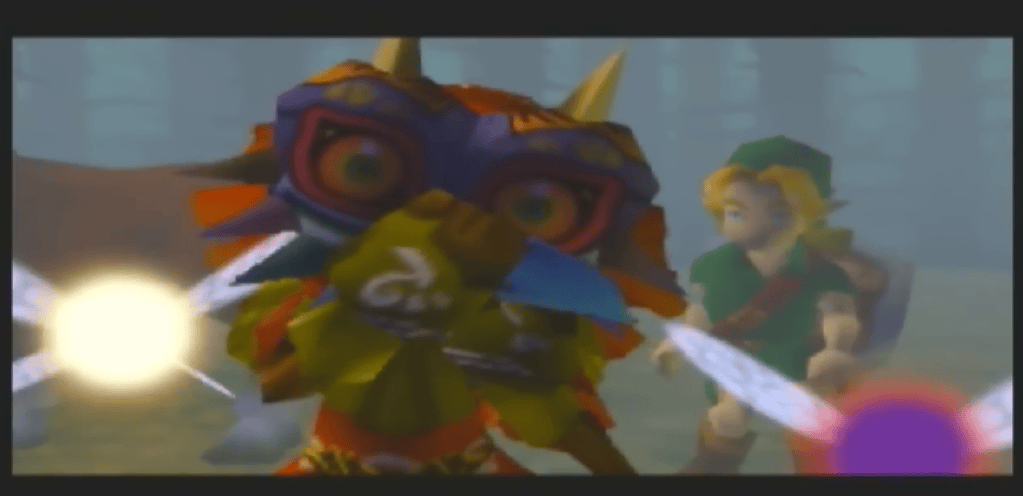
Link is then transformed into a Deku scrub by Skull Kid. For context, the Deku are a fictional race within the Zelda universe. The idea of using masks to transform or for different purposes is a recurring mechanic throughout the game. Link is then introduced to the happy mask salesman and Clock Town, kicking off the main events of the game.
I won’t delve super deep into the lore as I could easily gush for days about this game and the Zelda franchise as a whole. I could mention the amazing side quests such as Anju and Kafei, or the smaller details like the Deku scrub mask originating from a deceased child Deku. However, I wanted to focus on my key words relating to these games. Nostalgic and eerie, in this case.
I would also like to discuss my thoughts on genres, ratings and how these will influence my project. In my opinion, games are much more complex pieces of art than most give them credit for. This is why I’m often hesitant to label games as falling under one specific genre, or rate a game on a linear scale.
Is there such a thing as objectively good or bad? In my opinion, it depends. Looping back around to Zelda, I’ve seen a lot of people claim that Breath of the Wild and Tears of the Kingdom are “great games on their own, but bad Zelda games”. While I personally disagree with this sentiment, I do see where these people are coming from. As mentioned, there is no denying that this duology was a massive departure from previous titles.
Before the release of Breath of the Wild, a lot of open-world games were more linear in structure. What I mean by this isn’t so much that the worlds weren’t open, but that they felt that way, usually due to strict mission structures which punish creativity or waypoints littered across the mini map. I have nothing against any of these games, but a world like those in Assassin’s Creed or Grand Theft Auto are much different than Breath of the Wild, despite both being labelled as “open-world”.
All this is to say that finding a niche is important, especially in the indie space. Obviously Nintendo is no indie. However, I do find that they are willing to take more risks than most AAA developers and studios. Their creativity doesn’t always pay off, but at the end of the day, they are one of the biggest video game companies for a reason.
Research – philosophy, history and politics
I have found an interesting website (Read Philosophy) which contains a public (and free!) collection of philosophical works, ranging from Anaximander to Friedreich Nietzsche. There is also A collection of over 120 philosophy reading lists organised by topic – The Daily Idea, which functionally acts as a collection of good starting points for reading philosophy.
First, I would like to properly define philosophy. So, what is it? Philosophy comes from the Ancient Greek word philosophía, which translates to love of wisdom. To put it simply, philosophy is the study of fundamental and general questions concerning topics such as, but not limited to; existence, knowledge, mind, reason, language and value. Historically, scientific subjects such as physics and psychology fell under the philosophy umbrella. Modern philosophy tends to be its own thing, at least academically, although there is still some overlap. Western philosophy originated in Ancient Greece and it covers a wide array of philosophical subfields.
There are a few major branches of philosophy, including epistemology, ethics, logic and metaphysics. To summarise, epistemology is the study of knowledge itself and how to obtain it. Ethics revolves around morals, their principles and what constitutes right conduct. Logic is the study of reasoning and what separates a good argument from a bad one. Metaphysics examines the most general features of reality, existence, objects and properties. There are also plenty of other branches and subfields of philosophy. A few of these include aesthetics, philosophy of maths, philosophy of science, philosophy of history, etc.
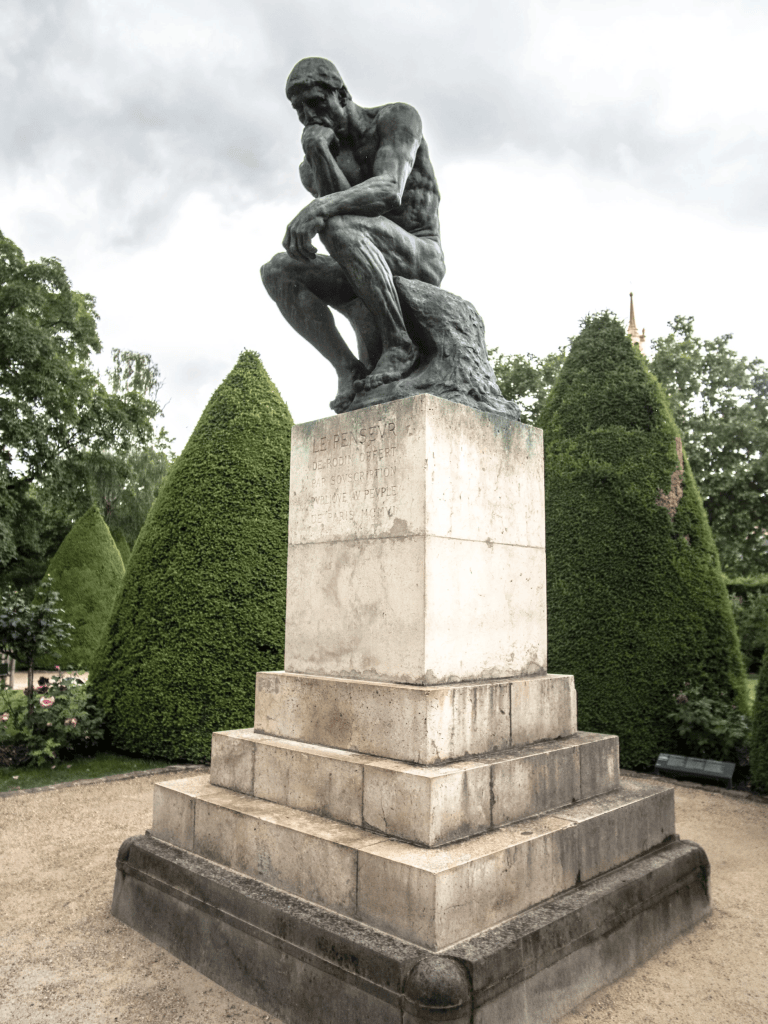
Generally speaking, philosophy revolves around systematic thinking, rational inquiry and critical reflection around its own methods.
The philosophical pursuit of wisdom does not always provide a clear answer to a problem one is having. It may even obscure the answer, if there is one, even more. It does, however, often help a person understand the topic on a deeper level.
“The unexamined life is not worth living” is a famous dictum from equally famous philosopher Socrates. It was supposedly said at his trial for impiety (lack of proper respect for something considered sacred) and “corrupting” the youth, for which he was subsequently sentenced to death. I personally have mixed feelings on this quote. On a deeper level, the quote essentially means that a life devoid of deep and critical thinking, self reflection and introspection is not worth living. I believe that all life is precious. However, we also have to take into account that this was in 399 B.C. Ergo, general perception on topics such as life and death were very different to how we see them now.
To summarise the situation, Socrates’ statement above relates to his understanding of death and commitment to the goal of understanding the Statement of the Pythia. Socrates understood the Pythia’s response to Chaerephon’s question as communication from the God Apollo. This became Socrates’ raison d’etre. (Reason for living) Since Socrates was religious, he preferred to search for the truth in the after life than continue life in exile.
Socrates believed that philosophy — the pursuit of knowledge and wisdom — was the most important thing above all else.
Socrates’ teachings were not directly documented. All that is known about him comes from others. Most notably; Plato and Xenophon — his pupils — Aristophanes and Aristotle, pupil of Plato.
The reason I’m talking about all of this here is not only because I find these topics fascinating, but also because they relate to my project in the sense that I want my project to have deeper meaning.
I would also like to quickly talk about the etymology of the word ‘nostalgia’. The word is a compound deriving from Greek. It consists of nóstos, meaning homecoming and álgos meaning pain. It was coined by a 17th-century medical student.
Up next, I would like to discuss the history surrounding Fitzharris Castle/Estate in Abingdon, UK. I am choosing this location to base my castle area on because it is nostalgic to me, having grown up near that area.
The former castle was originally constructed in Abingdon between 1071 and 1081 by a minor Norman lord named Owen. It was a rather small structure. It was comprised of a motte surrounded by a moat. Owen’s lands eventually became a manor on the edge of the settlement. By the 1240’s, this land was owned by his descendant, Hugh Fitz-Harry. The castle remained defensible.
In 1247, there was an infamous dispute between the Abbey and Fitz-Harry for control of the surrounding area. This carried on until 1284, until the Abbey recovered control from Fitz-Harry. The manor later became known by variants of his name — most notably Fitzharris and Fitzharrys.
Fitz-Harry was described to be an unpopular lord. He would eventually decide to become a crusader, putting his lands up for sale and associating himself with the Templar Order.
A wealthy noble, Richard, Earl of Cornwall, was keen to acquire the estates. However, Fitz-Harry made a deal with the Abbey to buy them for nearly 1,000 marks. Marks was the currency at that time. Unfortunately, I wasn’t able to figure out how much this would be worth in today’s money. Probably a large amount. Anyway, the Abbey also threw in a chaplain and provisions for him and his son for the rest of their lives. They would pay 300 of the sum up front at the Feast of St. Michael, and the rest the following year. Otherwise, the agreement would be null and void.
Fitz-Harry ended up having second thoughts, barricading himself in the castle and refusing to let the prior in. After some negotiation with the Abbey’s spokesman, they backed down. He agreed to leave the castle and take the money.
The castle fell out of use shortly thereafter, but the manor was rented out by the Abbey. After the Dissolution of the Abbey in 1538, ownership of the manor was passed to the new Borough of Abingdon, who continued to rent it out for the next three centuries.
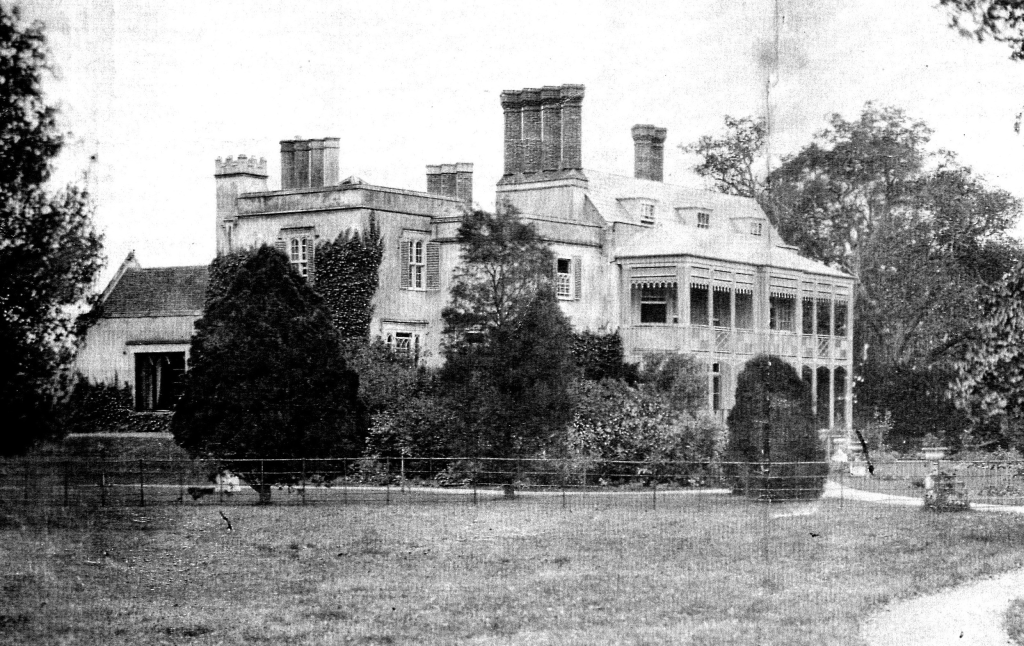
The house was rebuilt in Tudor style and occupied by local families. In the late eighteenth and nineteenth centuries it was again remodelled.
The Borough of Abingdon ended up selling the estate in 1862. This led to the area being slowly developed for housing. The estate was used during World War II for a girls’ school, which evacuated from Kent. The manor house was demolished in 1953. There are a few surviving features of the estate. Much of the wall separating the estate from the town survives, alongside the motte, which features a monument. The area was placed on Heritage England’s ‘buildings at risk’ in the 2010’s.
Fitzharris estate is an interesting part of local history. At some point, I would love to photograph the remains.
Research – literature
Reading list:
- 1984 (George Orwell)
- Brave New World (Aldous Huxley)
My above reading list contains two of the most popular philosophical literary pieces in history.
Ideas
Even during the first few days of this project, I have thrown around a lot of different ideas. When I got my first key word, makeshift, I initially planned out a more desolate environment. Something along the lines of a post-apocalyptic society thrown together after an incident. I especially liked the volcanic eruption idea. I wanted to do a small area which players could explore with all the appropriately-themed props and set pieces. I also toyed with the idea of a mentally unstable protagonist character, which, in my mind, falls under the makeshift theme in a more abstract and metaphorical sense.
When I got my next word, nostalgia, my idea was flipped on its head. At first, I thought I could play around with the idea of a post-war world. The game would revolve around a soldier. The player would be able to press a button on their keyboard or controller which would trigger the environment and the player character to travel back in time to during the war. This idea would tie in with the nostalgia theme. Instead of this idea being actual time travel like you might see in a movie, it would be within the protagonists mind. Since their backstory would have involved them fighting in the war, they may have suffered from some form of PTSD that triggers whenever they visit those places.
Another potential avenue for ‘nostalgic’ would be a game set during the past. I’m aware this is a very broad description, but it may give me the chance to research some historical periods I find interesting. This could theoretically include any point in history. However, since there is obviously nobody still alive from the vast majority of historical periods, I struggle to justify using these. I’m thinking more so along the lines of twenty-something years ago. This is because I wanted something that a lot of people can feel nostalgic for, while also being personal to me.
There was also the matter of my third word. ‘Eerie’. Even though I’m early on in this project, I haven’t got many ideas for this word. One idea I have is to focus on trying to incorporate eeriness into the atmosphere and backstory. I could achieve this by giving the player character a tragic past, or using a moody colour palette. Or I could use both of these ideas.
So far, I am certain on a few key aspects. I want my game to feature a third-person perspective in a similar fashion to the Paper Mario series.
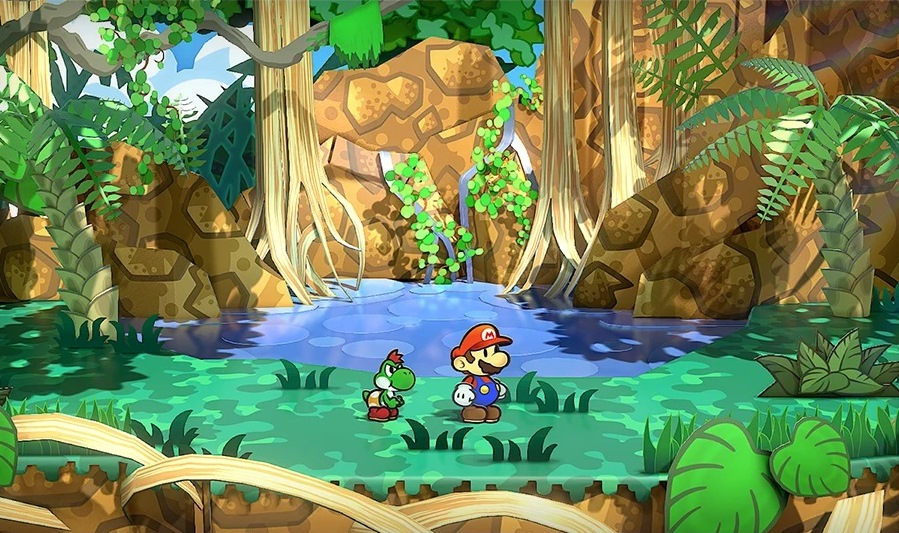
I want to interpret this art style in my own unique way. This can be part of the ‘makeshift’ theme, as I consider the crafty/handmade style to fit under this criteria. I really like this style because it gives off a sense of childlike wonder, which also ties into my nostalgic theme. It is also just very visually appealing.
Another source of inspiration could be the Yoshi games. The 2D Yoshi games always have super appealing art styles, in my opinion.
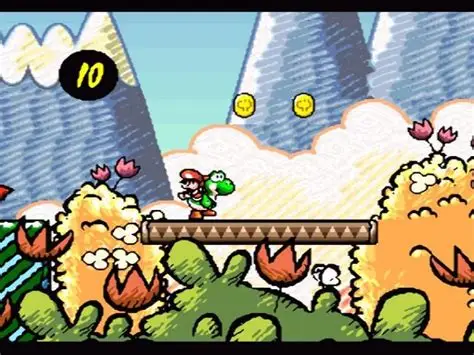
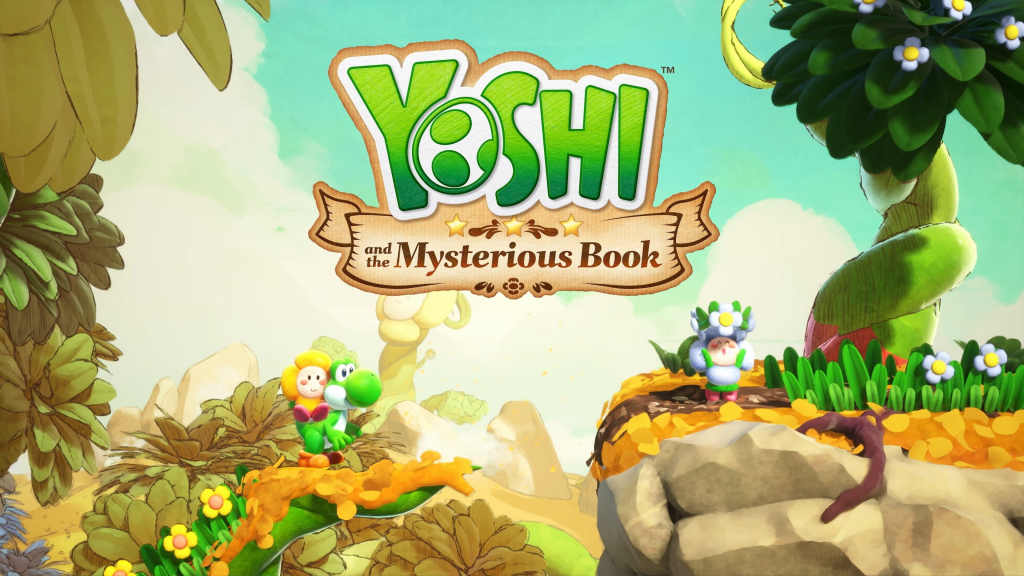
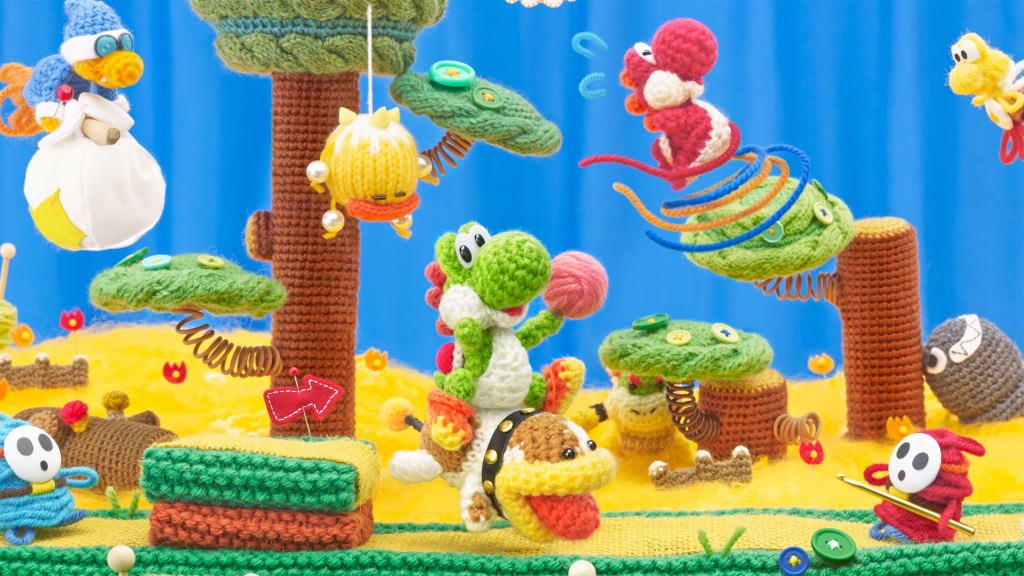
I especially like the art style for Yoshi’s Island. Despite the fact it is an SNES game and is over 30 years old, the visuals — and every other aspect of the game, for that matter — still hold up extremely well. As with Paper Mario, I think the art style gives off strong nostalgic vibes. This is because the visuals look as if they were hand-drawn by a younger child using crayons and pastels. This may sound like I’m framing it as a negative, however I can assure anyone reading that this is a sure-fire positive as it reinforces the creative and nostalgic feel. I would also like to quickly bring up the fact that Yoshi’s Island came right after Donkey Kong Country, which used 3D models rendered as 2D sprites. This was naturally a huge departure from that style.
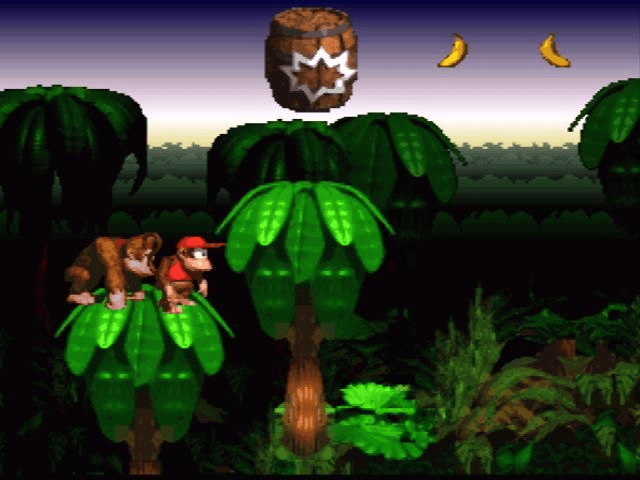
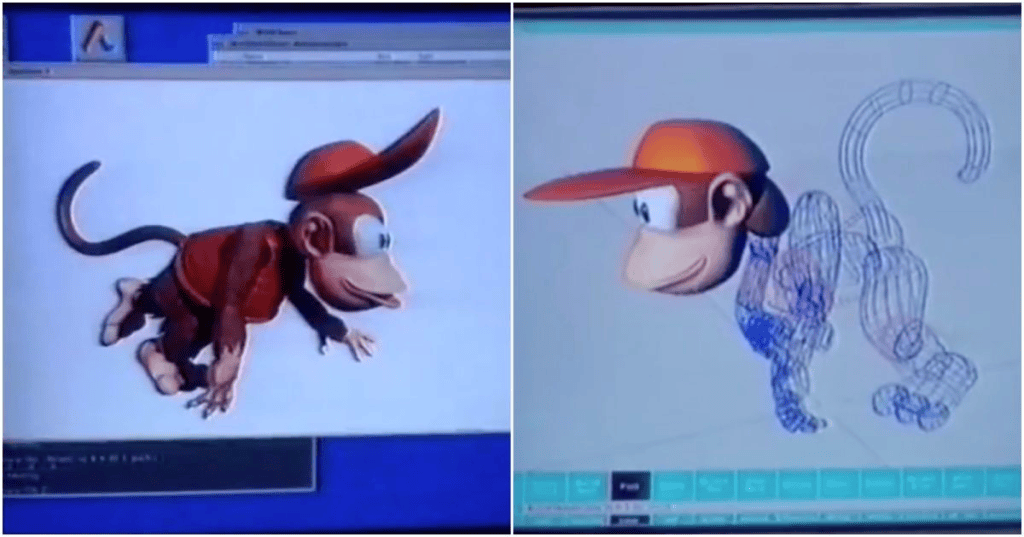
This is purely a personal preference thing, but I slightly prefer the art style and aesthetic of Yoshi’s Island to Donkey Kong Country. Both games hold up extremely well today, of course. As is the same with a large chunk of the SNES library.
These ideas also relate to my ‘nostalgic’ key word. I could make my game in a pseudo HD-2D art style, which is heavily inspired by the SNES era. Notable uses of this art style include; Octopath Traveller 1 & 2, Live A Live, Unicord Overlord and Final Fantasy Resonance. This art style is usually defined by pixel art characters in a 3D world and a top-down camera angle. I have also noticed that a lot of these games will often utilise very moody colour palettes and low-ish poly assets.
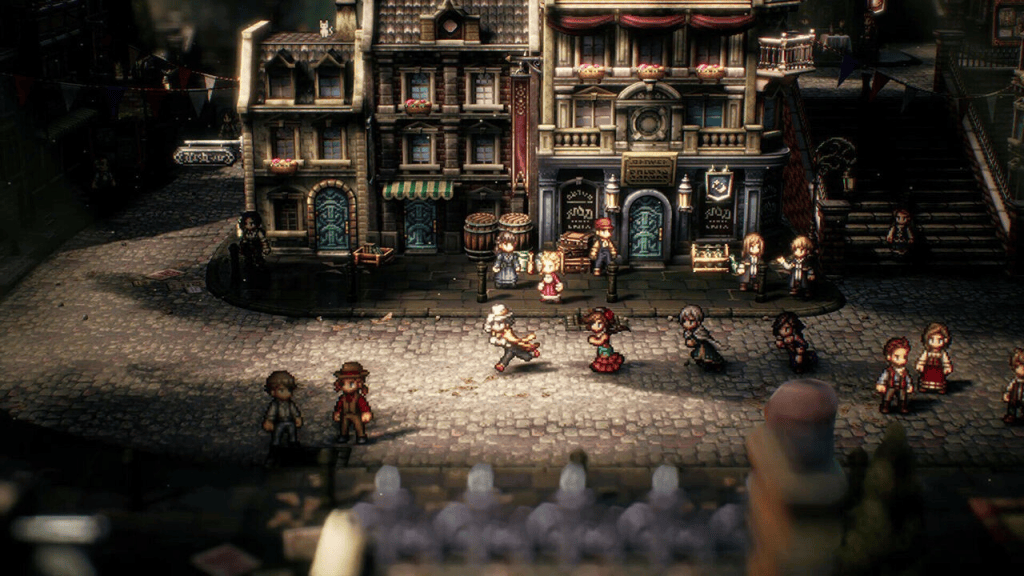
This art style would also come with the benefit of minimising time spent 3D modelling characters. As much as I enjoy 3D character design, it takes up a vast amount of time and with my current skillset, it might not provide adequate results first try. This would lead to even more time being used up.
I also want to utilise nostalgia in a more abstract and thematic sense. My game could contain props and imagery that remind me of my childhood.
So far, I have a few ideas which I am fairly certain I will stick to. First, I know that I want my game to have pixel art, or otherwise 2D characters. I want the game’s style and aesthetic to be based on early 2000’s England, meaning I will need to study English architecture. Next, I want the game to contain moody lighting. Last, I want the game to contain metaphorical messages about mental health and how it relates to nostalgia.
There are a few other ideas and questions I need to confirm. First, what happened before the player arrived? One idea I had was to set the game inside a dream. The dream could relate to the player character’s childhood and how they long for the return of that era. Or rather, who they were at that point in time. Just before the player character entered the dream, they suffered from a depressive episode. This is what triggered the dream.
What does the player see? The player will experience a small snippet of a town in England, including a few shops and houses. There will also be the inside of a house, which will function as the player character’s childhood home. This will contain various props, such as retro video game consoles, childhood pets, etc.
How will the player feel? The intended feelings for the player are coziness, familiarity and a slight edge of eeriness and confusion.
What was this place originally used for? The house was originally lived in by an unnamed family. I want to leave these details ambiguous in order to make the experience feel more personal to a wider group of people.
Dependent on time, I would like to include a ruined castle area to tie together my key words and the England setting.
I would also like to focus further on my colour palettes.
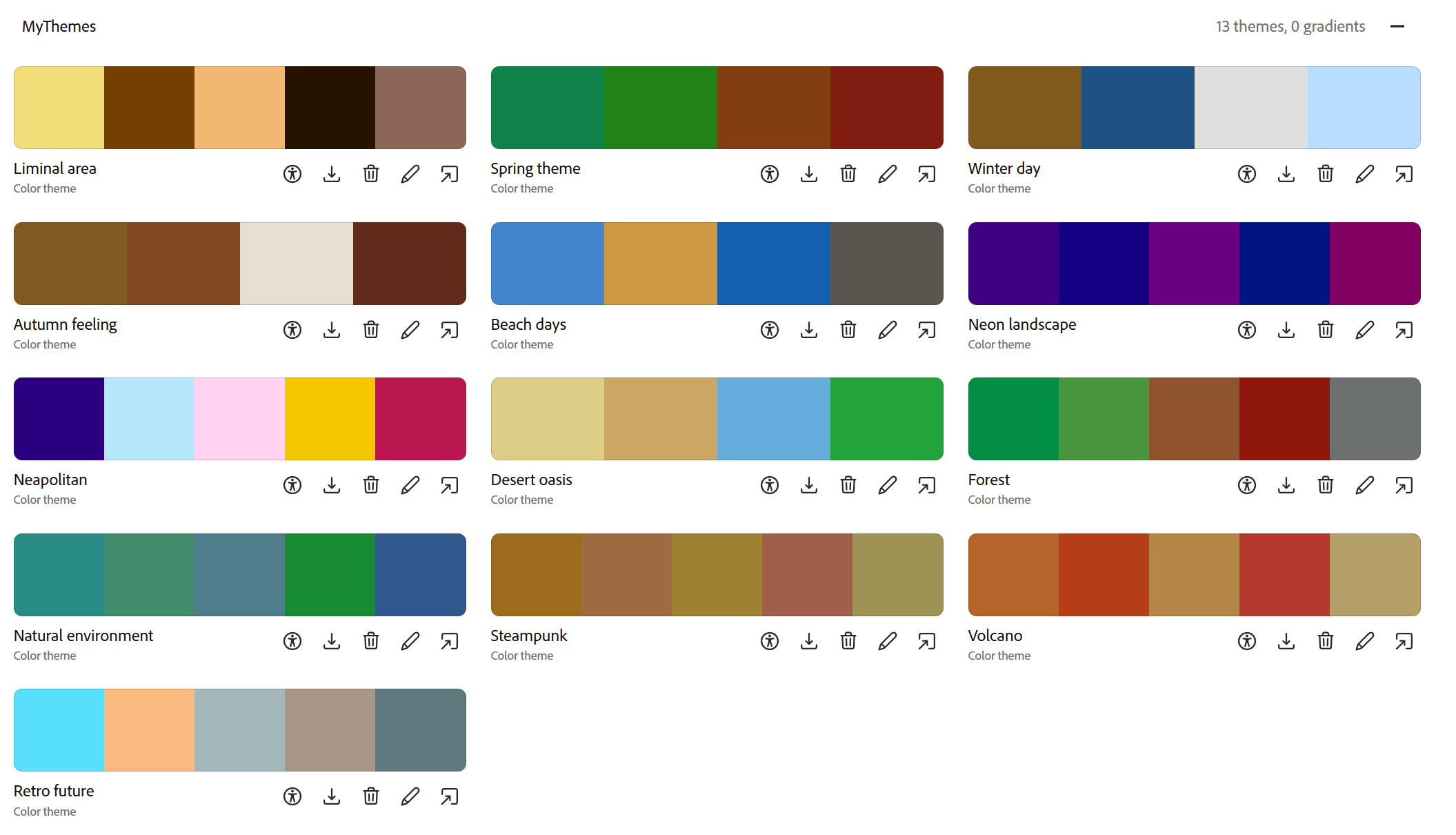
So far, I have the above colour palettes. At this point in time, I’m leaning towards a more moody palette. While the above colour palettes are nice, I think that only one or two of them are relevant to my vision of the final game.
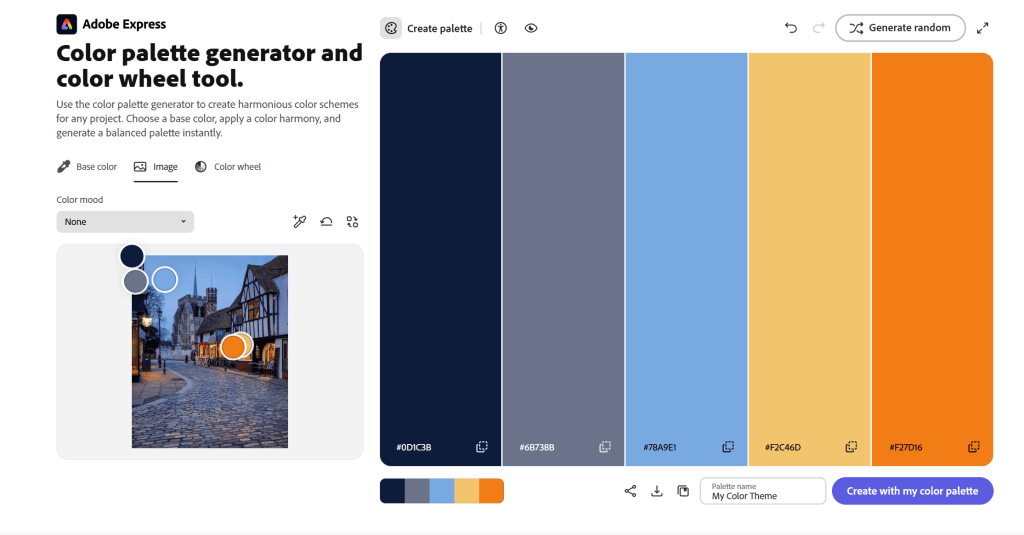
The above colour palette was based on the image I showed off earlier. I am going to try achieve a similar colour scheme in my final project. I already know that I want to utilise slightly different colour schemes for each area, so this one will be for my town.
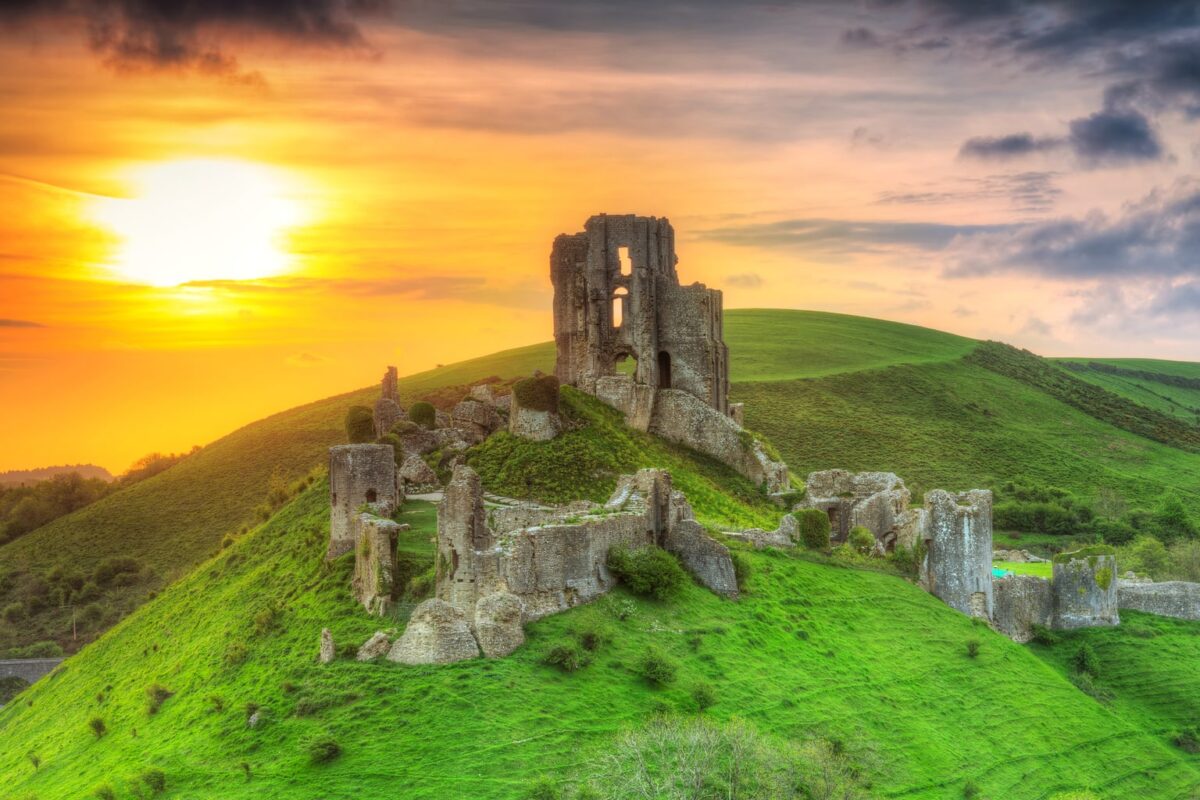
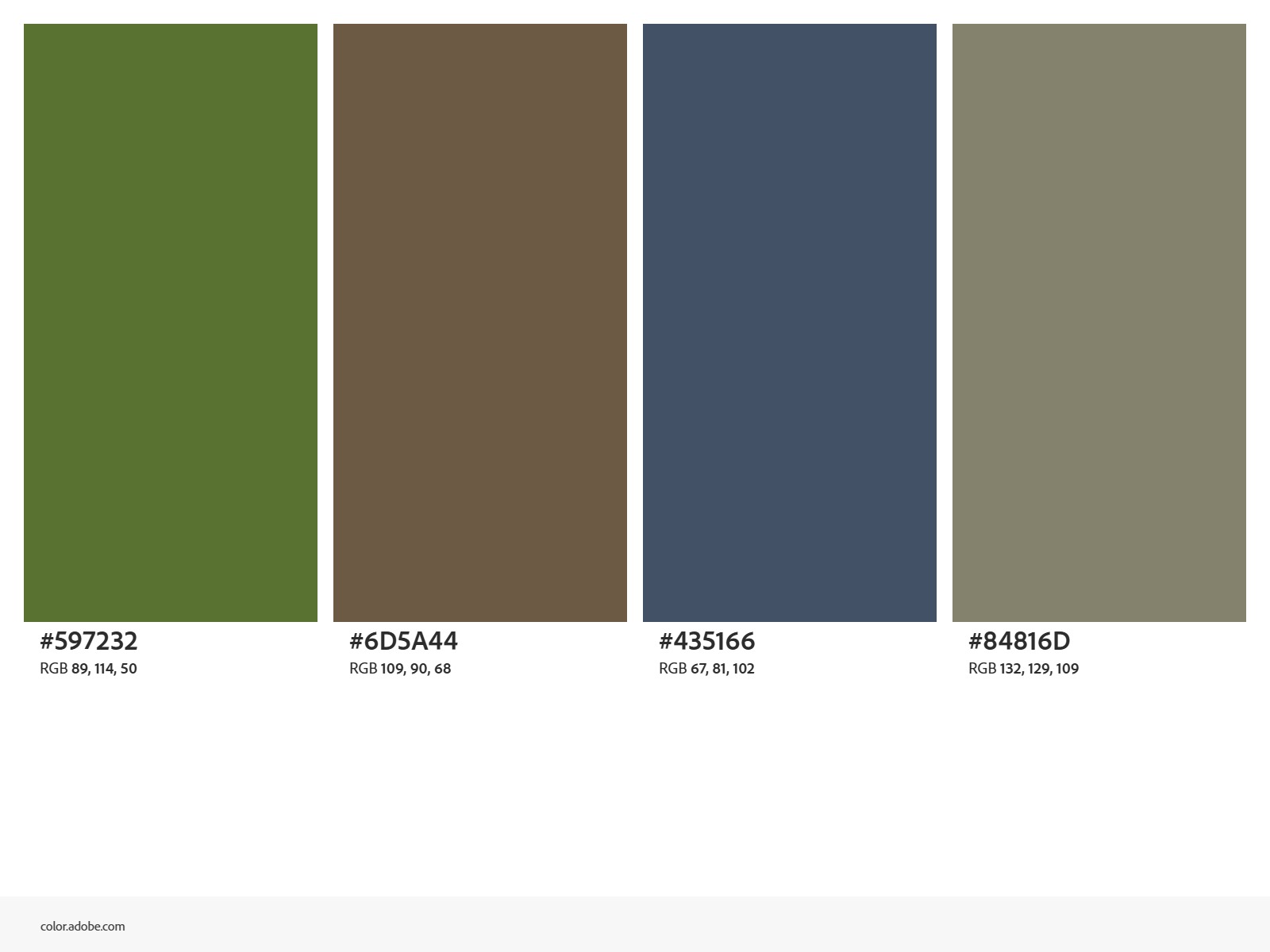
Above is a photograph of Corfe Castle and a colour palette inspired by it. I tried to cherry-pick a few of the darker colours in the photograph to compensate for the fact that my game will be set during the night time.
Concepts
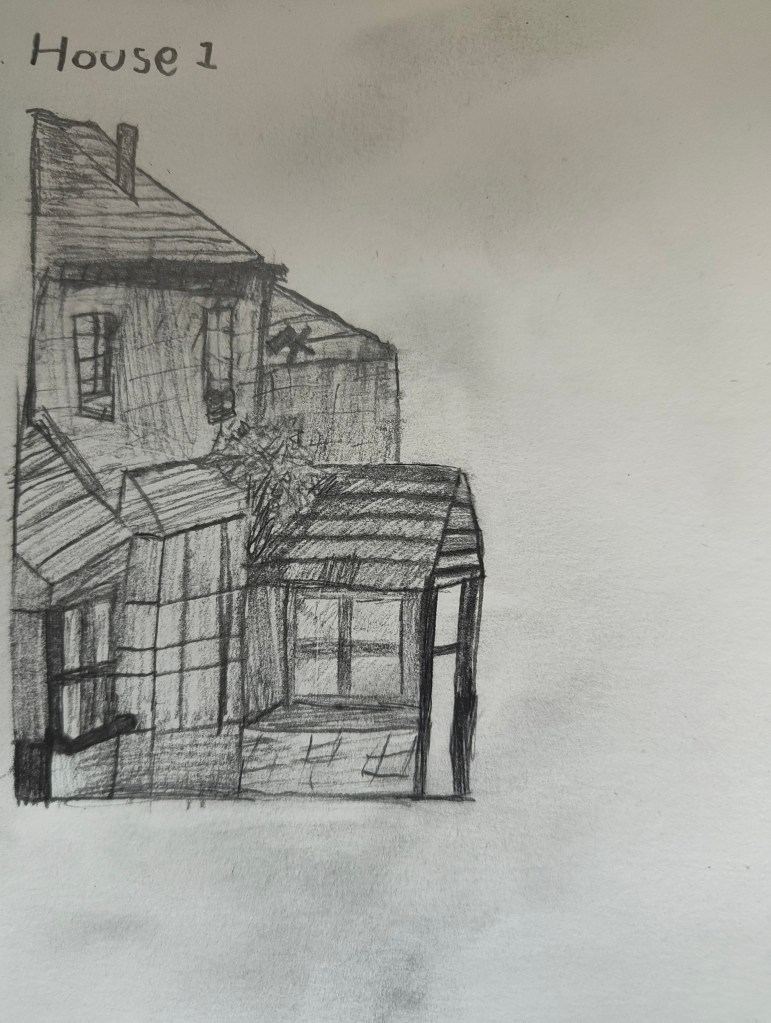
Above is a rough sketch of an English house. I drew this because I knew I wanted to base my game in England, because it relates to my own nostalgia, having grown up here.
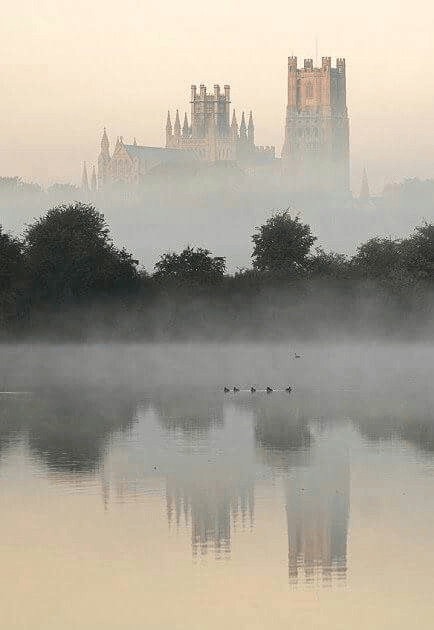
Above is a really appealing photograph of Ely Cathedral in Cambridgeshire. There’s a lot to pick apart in terms of composition — the reflections, the morning atmosphere, the fog, the incredible looking architecture, I could go on. Putting all that aside, this image could serve as a useful reference for my background.
Summary of my ideas so far: My game is set inside the dream of an unnamed person with mental health struggles. They miss their childhood. They miss their friends. They miss the feeling of having no worries. These struggles result in the protagonists’ dream world where everything feels okay. The mental health aspect was taken from my key word ‘makeshift’. I decided to go with a more metaphorical route. The imagery and environment of my game was more so inspired by my ‘nostalgic’ and ‘eerie’ key words. To achieve this, I will use a mixture of props, effects and imagery. Some of the potential props include; a CRT TV, a retro DVD player, a retro gaming system and others.
My project will likely contain a limited amount of NPCs. Despite this, I want to provide evidence to the player that this house was or is lived in. I intentionally want to leave the timeline ambiguous — the player may experience confusion on whether this house is lived in or was at one point in the past. How will I achieve this? I want to provide clues that indicate towards both of these outcomes. For instance, a cooking pot left on the stove and a makeshift gravestone in the garden may serve as useful storytelling props.
The message I want to convey with my game revolves around losing yourself in nostalgia and looking towards the future. Some may say that these two aspects juxtapose each other, but I think they link together well. I want my story to inspire people to utilise nostalgia to improve our future.
Environmental storytelling plan
Each area in my game will contain distinct imagery and vibes. First off, I want to talk about the town, which interconnects the rest of the areas. The main imagery for this area revolves around stuff you might expect to see in an English town. For example, shops, phone boxes, houses, a few plants, and street lights.
The castle ruins’ goal is to further establish the environment in which the game takes place. It will also convey the emotions of relaxation and serenity to the player. This will be achieved by the use of relevant sound effects and imagery. This may include; birds tweeting, overgrown fauna and the ruins itself.
The park/playground will function as an area which the the player can relax. This will be achieved by including a a lot of plants, a fountain, benches and other props one may expect to see in a public park.
Lastly, the house will be the most distinct area in the game. It is also intended to be the final area the player will explore. The house will feature rooms and imagery one would expect to see in a typical UK house. This can include; bedrooms, living rooms, bathrooms, the garden, etc.
Below is the first planned layout for my town map. The layout is subject to change as development continues, of course.
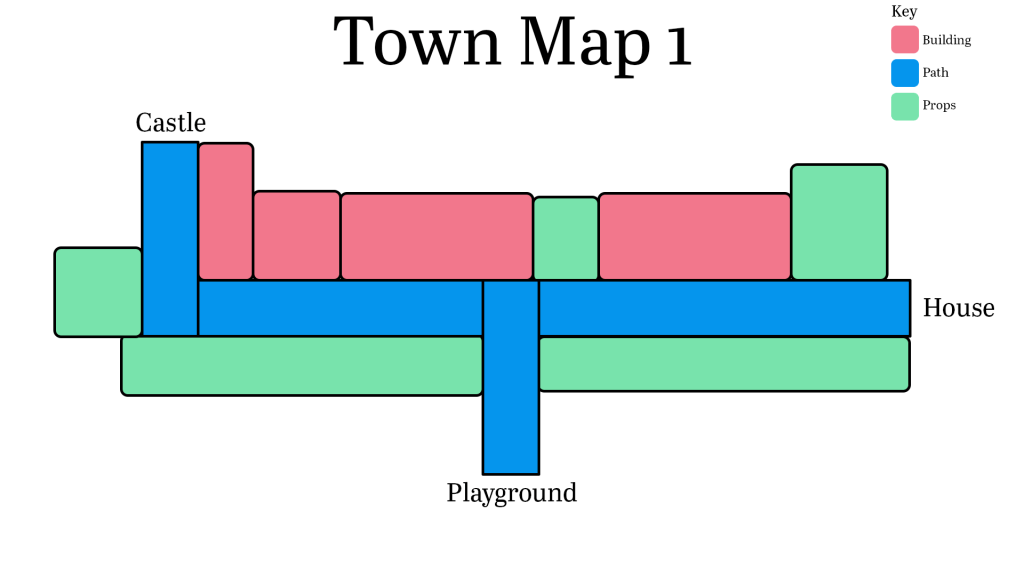
The green sections, props, will consist of different set pieces. Plants, boxes and other miscellaneous objects one may expect to see in a British town. The goals of these props are to provide an authentic way of stopping the player from going out of bounds, while adding some extra ‘flavour’ to the world. Some or all of the buildings in red may or may not be enterable, depending on time. The castle, playground and house function as separate areas with the town as a central ‘hub’.
Why did I only put buildings on the north side of the map? This is due to the games’ camera angle and art style. As I want to use a top-down perspective camera angle, it would not make sense to include huge objects that would either obscure the player’s vision or be invisible. This may not be completely realistic to how towns are designed, but that is the idea. This is my own interpretation of an English town. Not only that, but keep in mind that the map is set within a dream.
What will the buildings be/consist of? A variety of things. I’m thinking a gym, coffee shop, library, school, office complex and a supermarket. The school may end up being used for the playground area. Assuming I have the time to model and implement the interiors of these buildings, they will be suitably decorated and fitted out.
What secrets and discoveries will the player be able to find? I would like to include a secret(s) for most, if not all of the areas and sub-areas in my game. I’m still debating on what these could consist of. Since the use of written text and dialogue is extremely limited for this project, I shan’t create text dumps or any form of dialogue for the player. I could take the approach of leaving the digits to a code which the player must enter in order to finish the game. This would not only encourage exploration, but also get the player to think, even if it is just a little bit.
Next up, here is the map for the castle ruins.
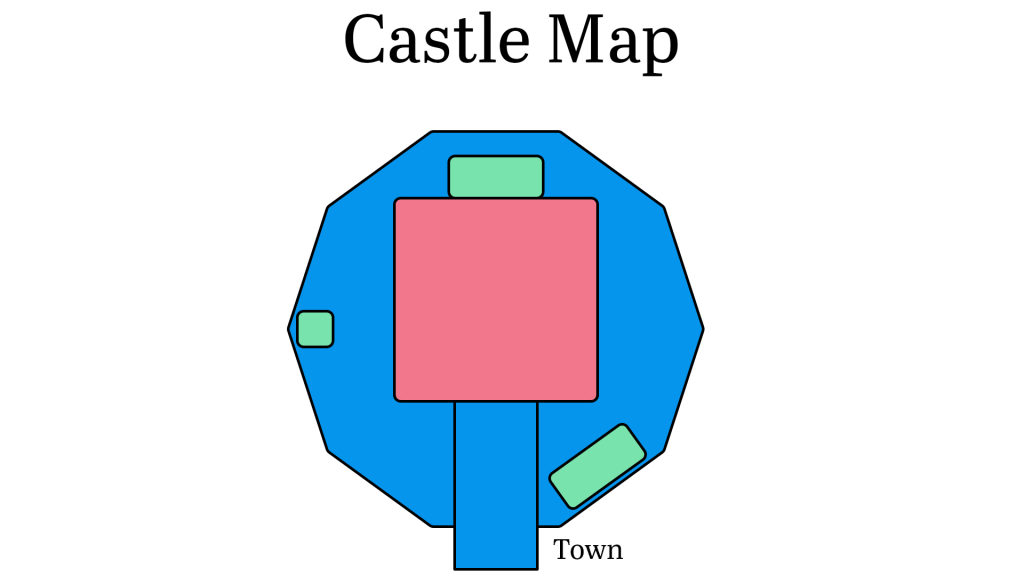
The castle area will be slightly more open-ended than the town, as indicated by the higher usage of blue in my map, which represents walkable paths.
Next up is the playground/park map. This area will feature a fountain as its central piece, alongside flower beds and street lights.
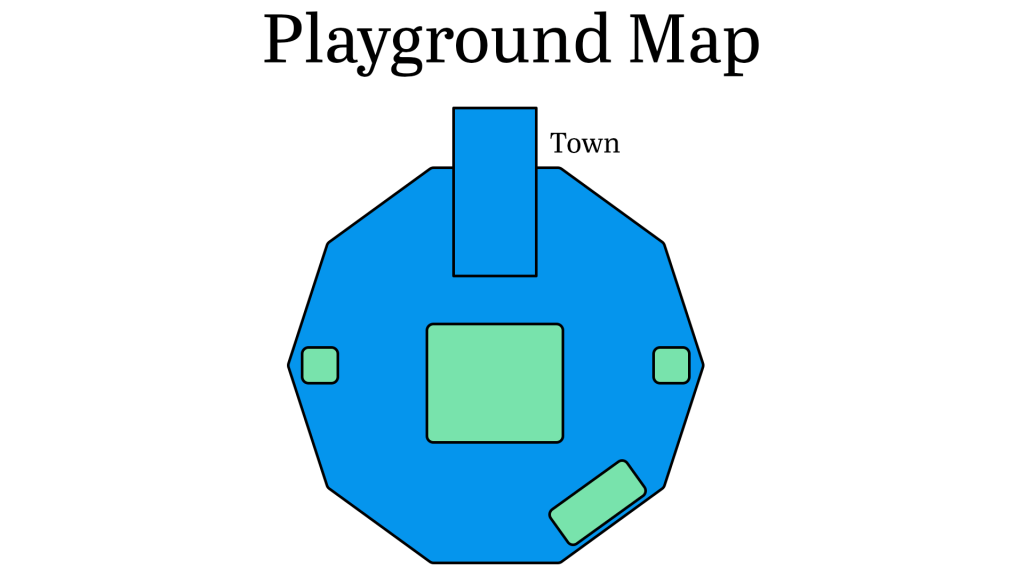
How do I intend to use scale and proportion in my game? I intend to use scale to make the world feel realistic, while also using proportion to reinforce the idea that this is a dream world. I will achieve this by trying to use realistic proportions for my environments wherever possible. One key point to mention is that my game lacks traditional camera controls as the camera follows the player. This will mean I have to be very intentional with how and where I place my assets.
For example, the castle areas’ main ‘attraction’ is the castle ruins. This will be front and centre when the player enters this area. I must take care that the player’s eyes are drawn towards the castle, while also ensuring that other details have a chance to shine.
Target audience
I wanted to talk briefly about target audience. Considering the subject matter of mental health struggles, I’m thinking my game would probably be 16+. In terms of who my game appeals to, it would mostly be those nostalgic for the early to mid 2000’s UK period. Not that younger audiences or those who aren’t from the UK wouldn’t be able to enjoy my game, but they might not get the same mileage as the intended audience.
This is also backed up by the genre of my game, which would be classed as a walking simulator. These usually aren’t the most popular genre of game. However, there are still plenty of great ones out there. Dear Esther, Gone Home, The Stanley Parable and Death Stranding are some good examples. Most of these titles have fairly ‘basic’ gameplay, which isn’t a bad thing in this case, because it also adds to their appeal. The lack of deep gameplay systems can elevate the storytelling aspect. However, plenty of people will also criticise the lack of an engaging gameplay loop. While I get where these people are coming from to an extent, I do think the argument misses out on what walking sims are often trying to convey.
Because of this, I would like to add that my game would also appeal to those who are already into walking sims. To reiterate, the main appeal of my game is for those who are nostalgic about mid-late 2000’s UK and are into walking simulators.
Production – 3D block-out
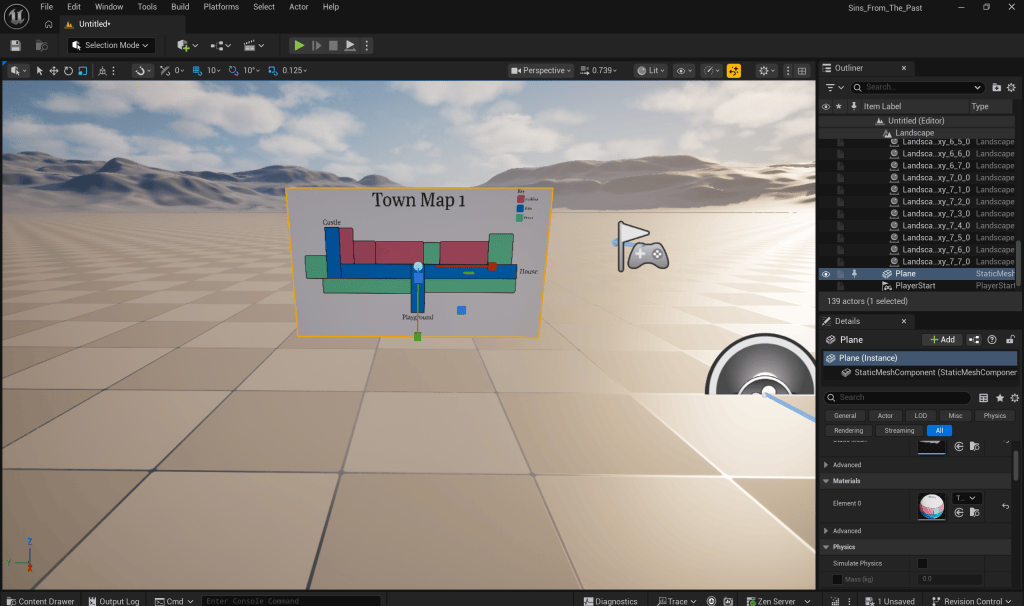
Above is a screenshot from Unreal Engine. I have imported my texture and used it on a plane which I will use as reference for blocking out my town.
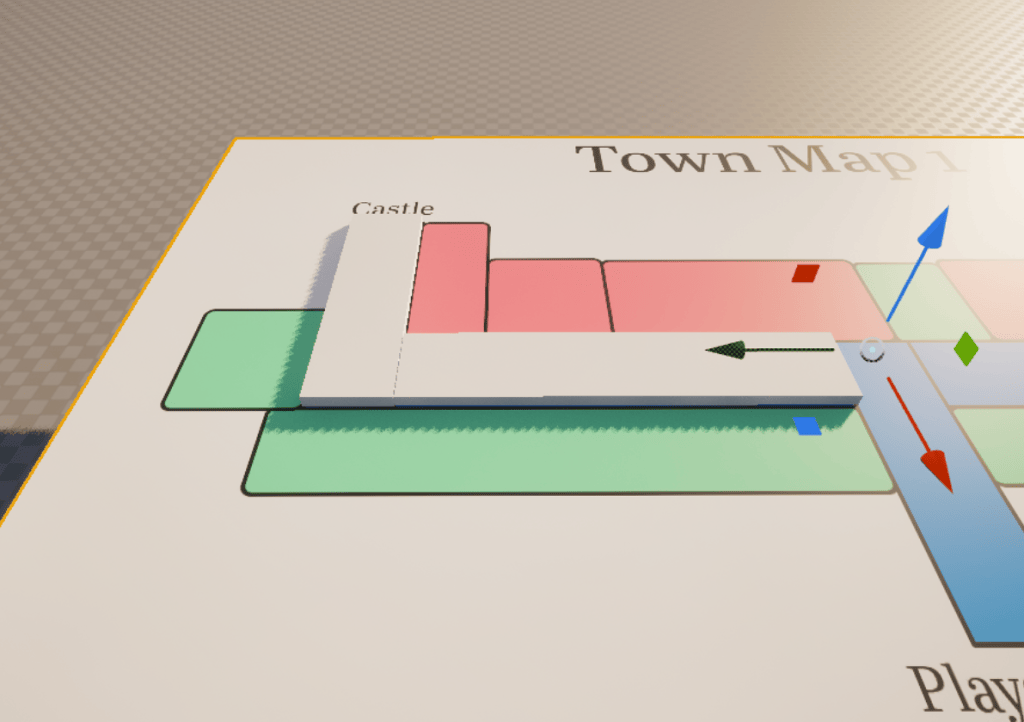
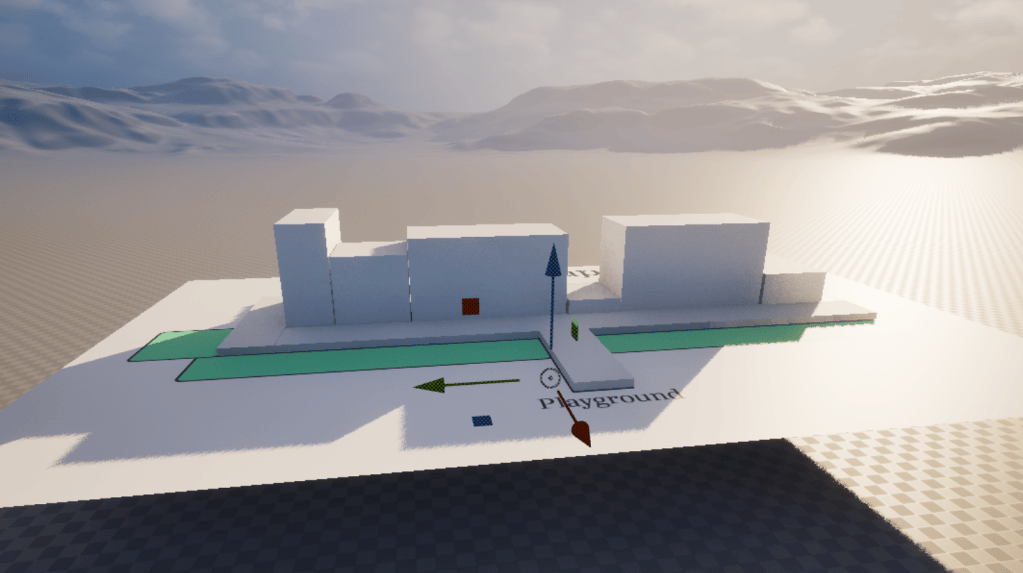
The blocking out of my first map (Town) is about halfway finished. I also want to have a play around with the lighting in order to achieve my desired effect.
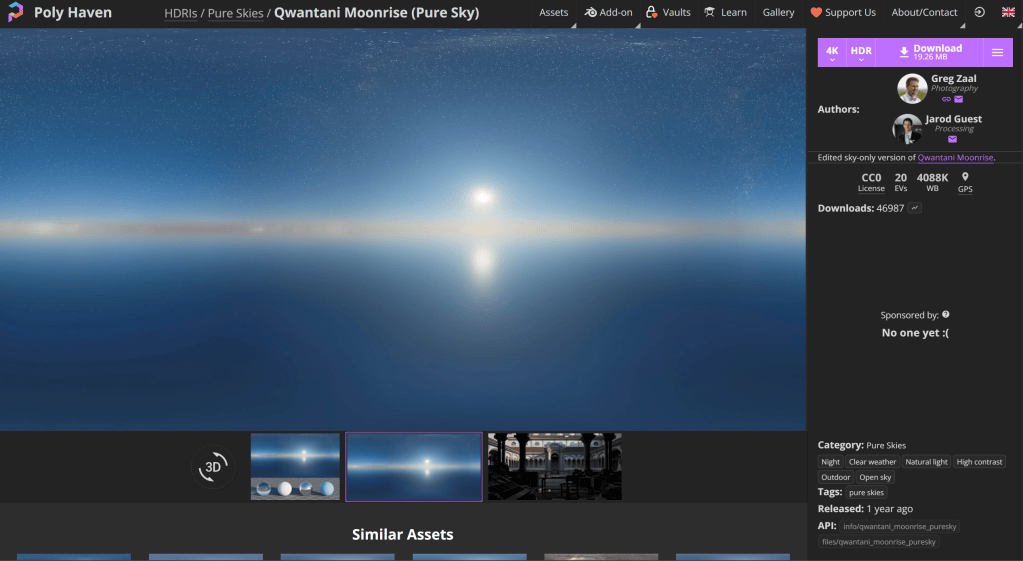
Additionally, using the built in HDRI backdrop plugin, I will create a different atmosphere for my levels.
My chosen HDRI is here.
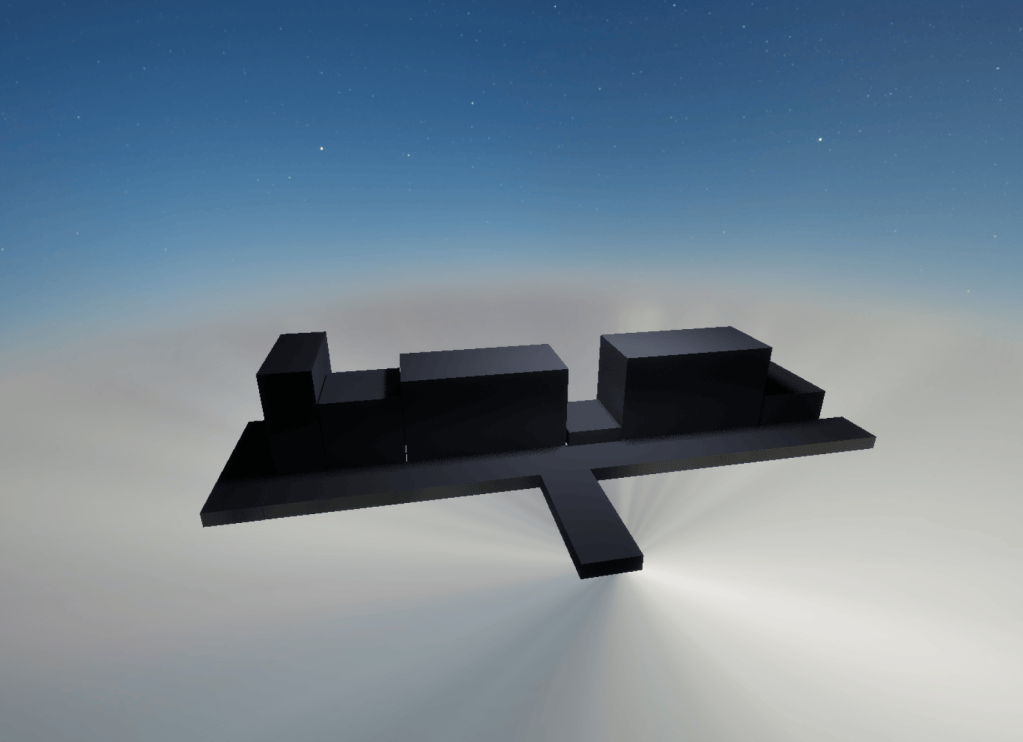
Playing around with lighting and the HDRI backdrop.
To-do:
- Finish up the town block out
- Adjust lighting to make the town map more visible
- Add some sort of filter
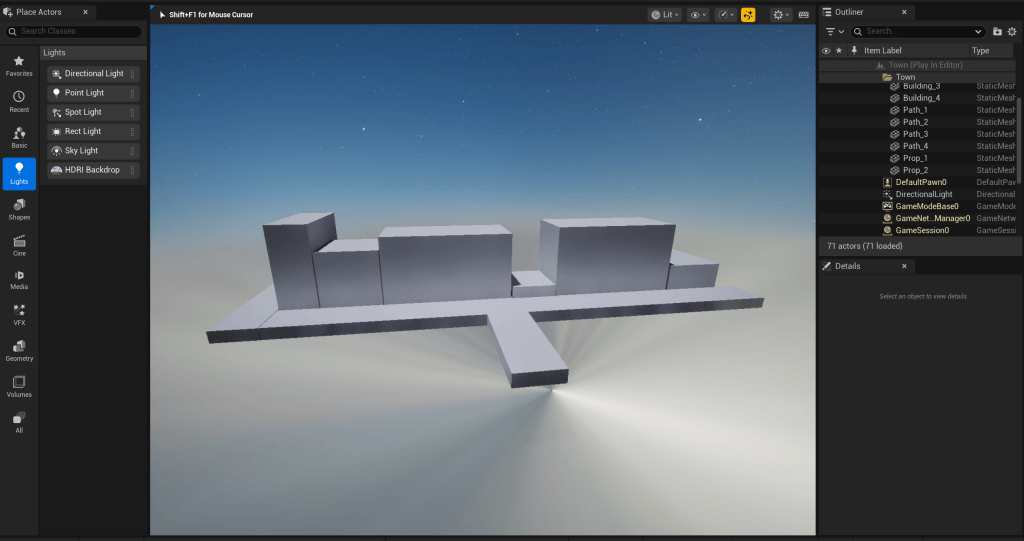
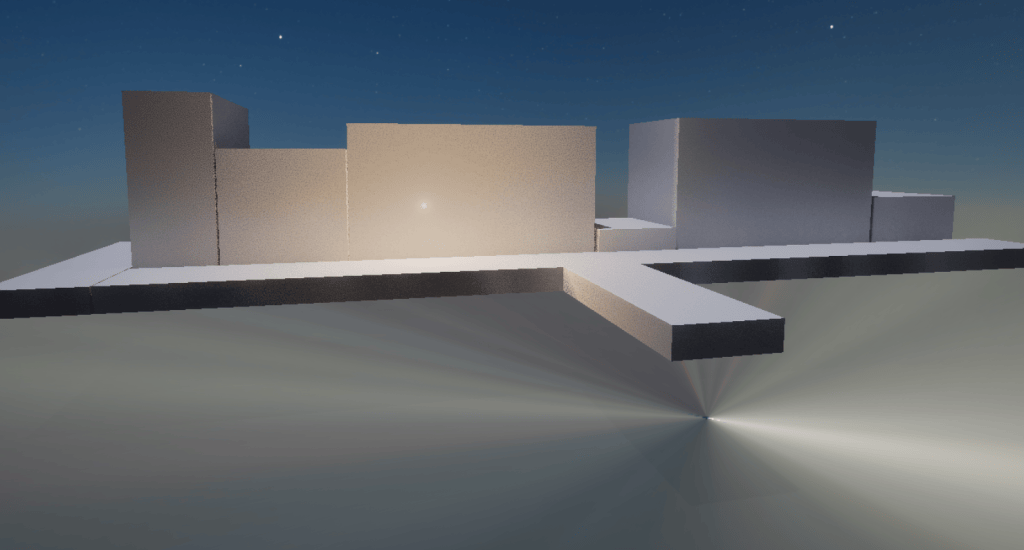
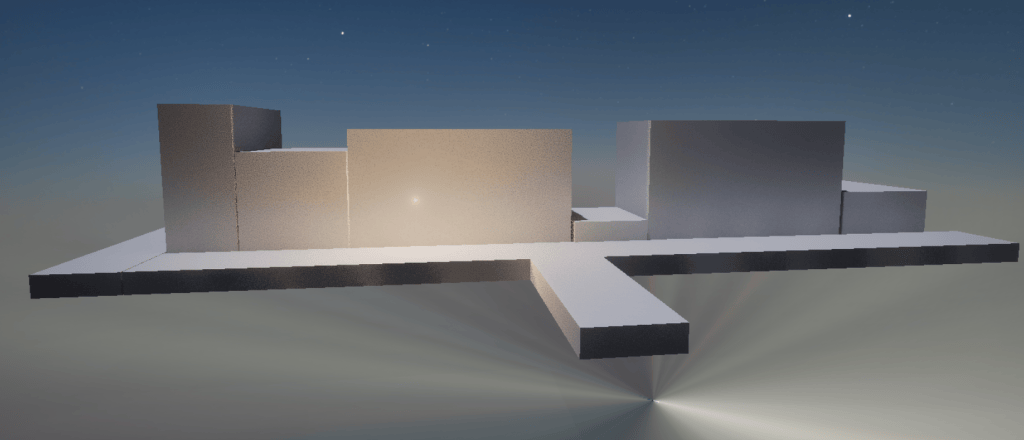
Playing with local fog volumes.
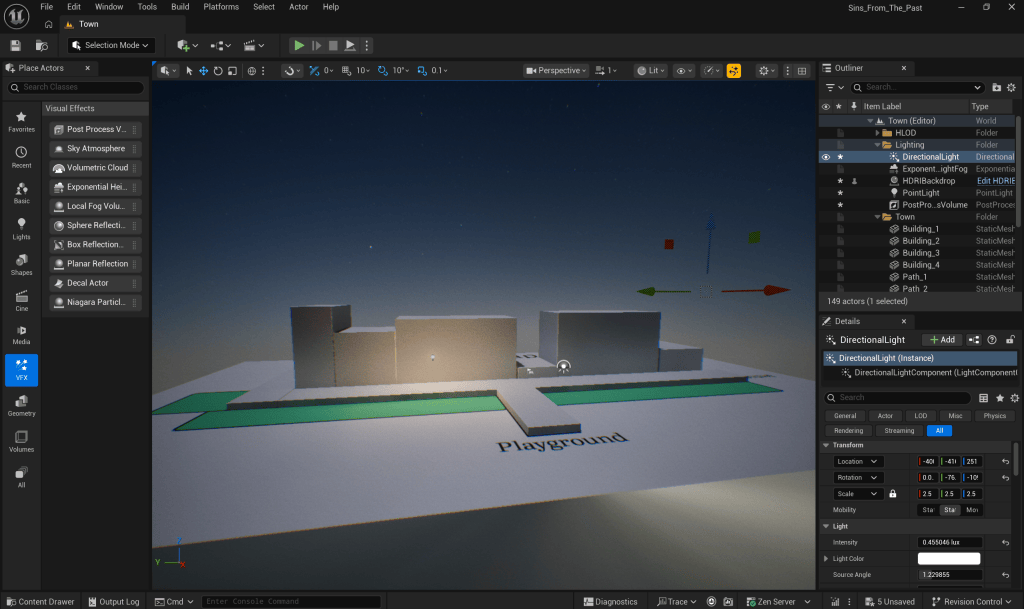
Adding filters to achieve my dreamlike feel.
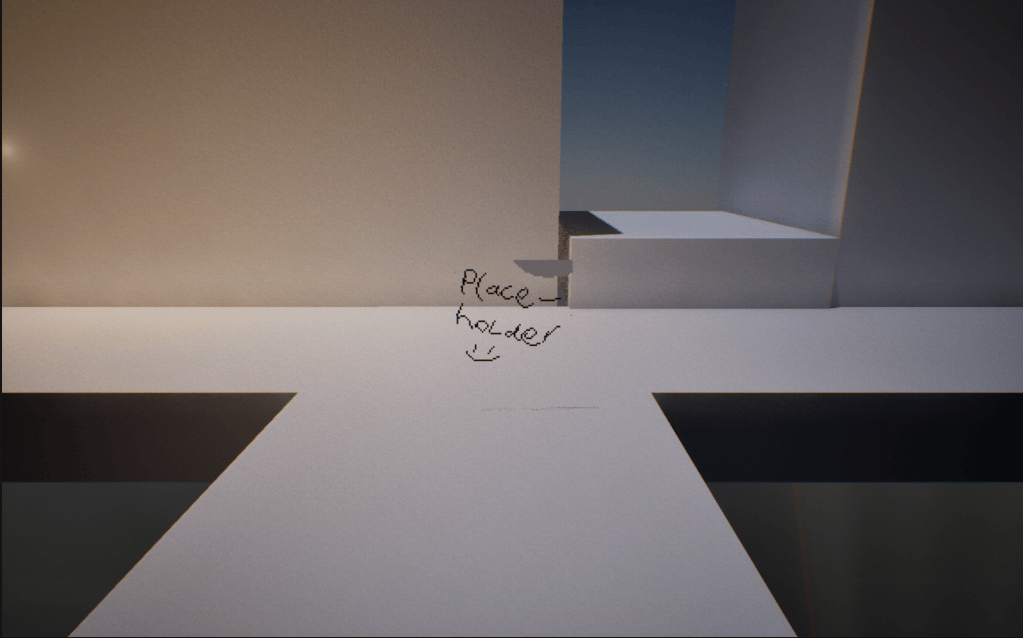
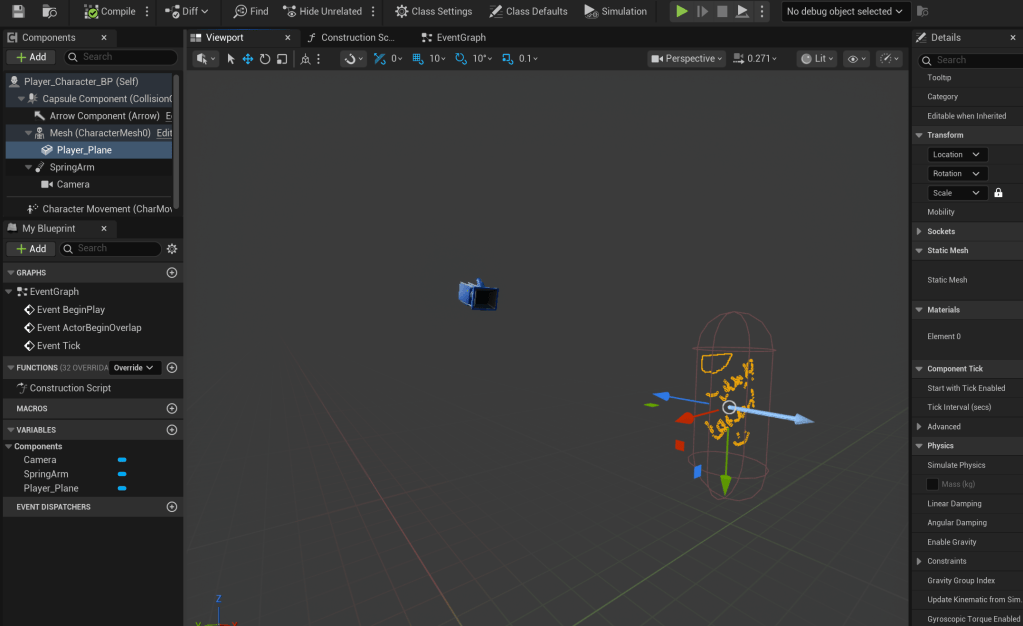
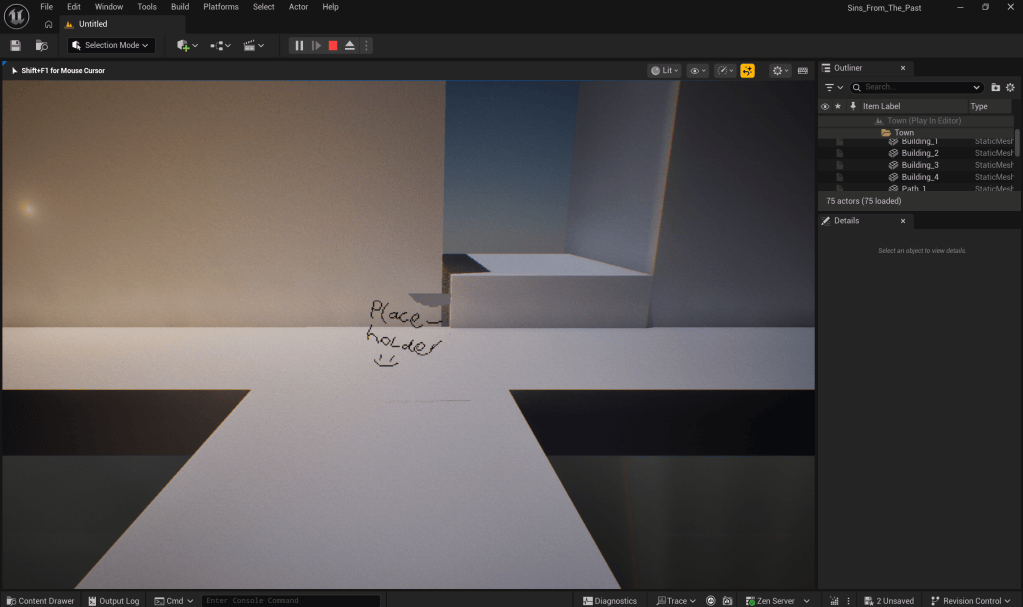
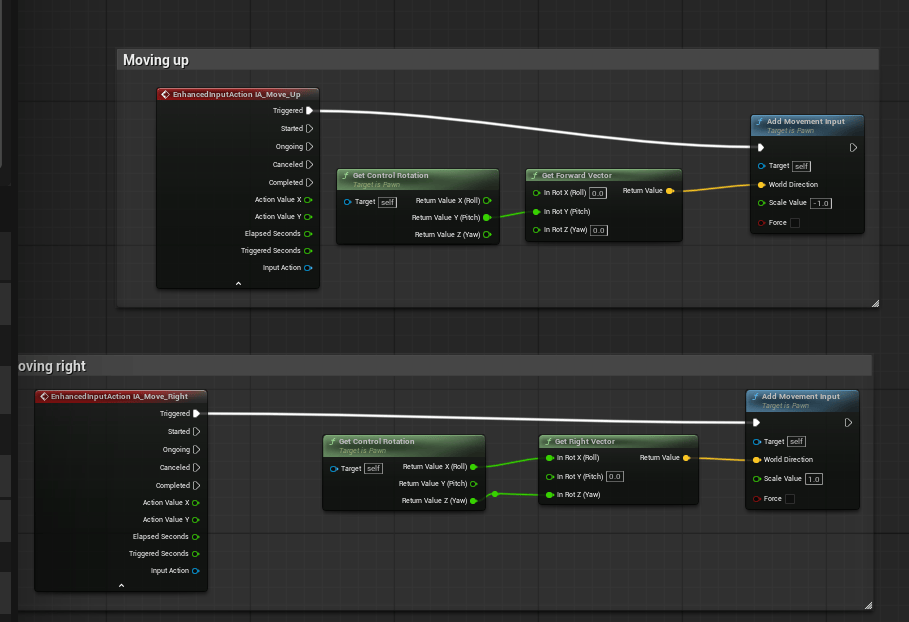
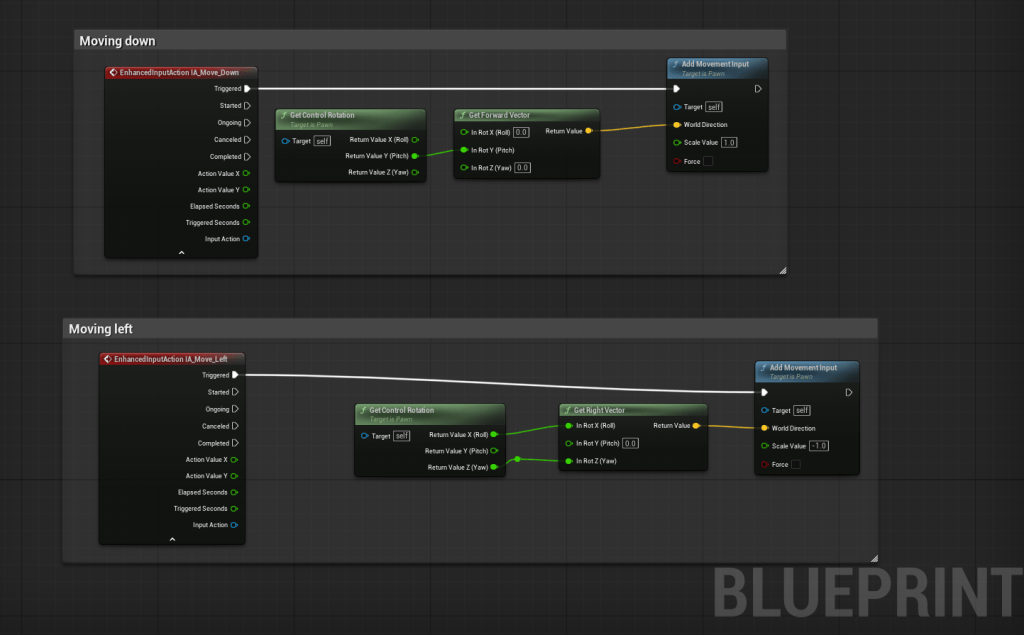
Creating basic movement for my character.
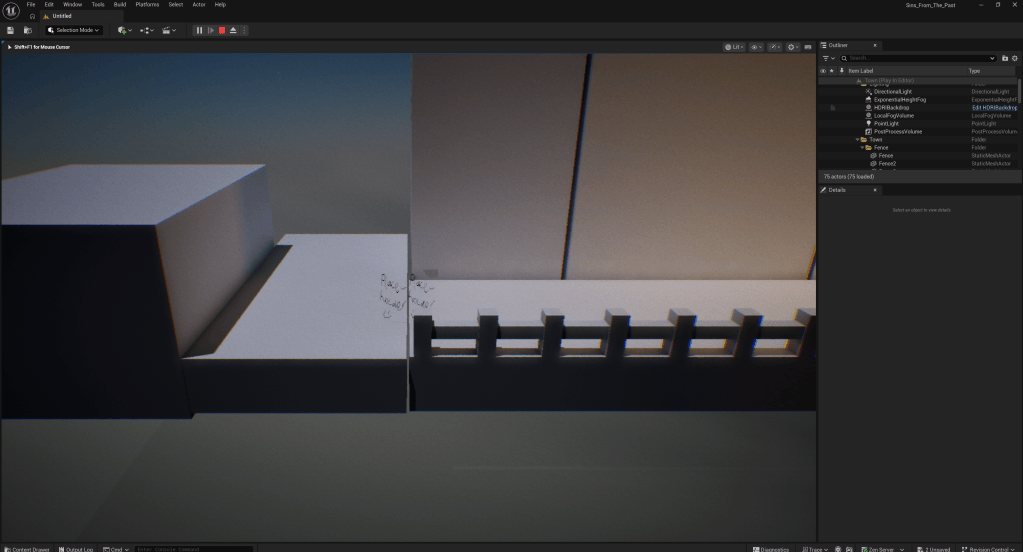
After some testing, I have come to the conclusion that the buildings are too high.
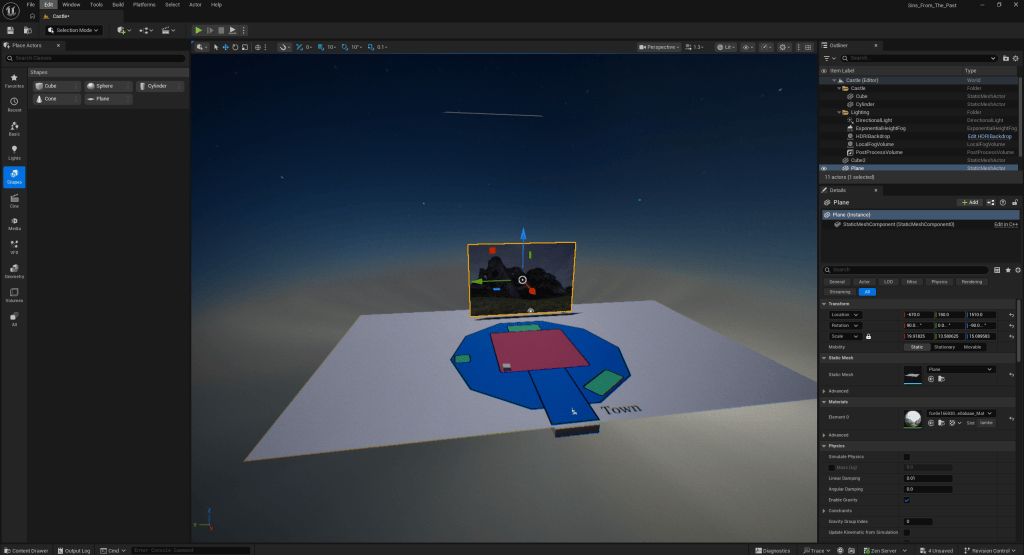
Beginning to work on the map for the castle.
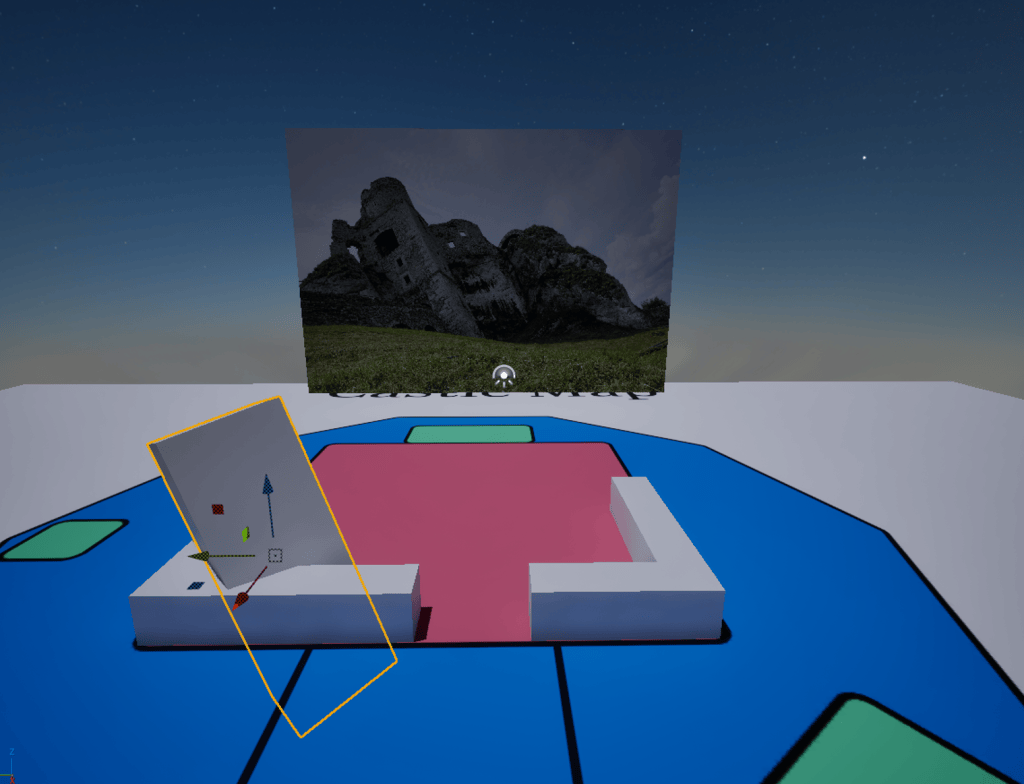
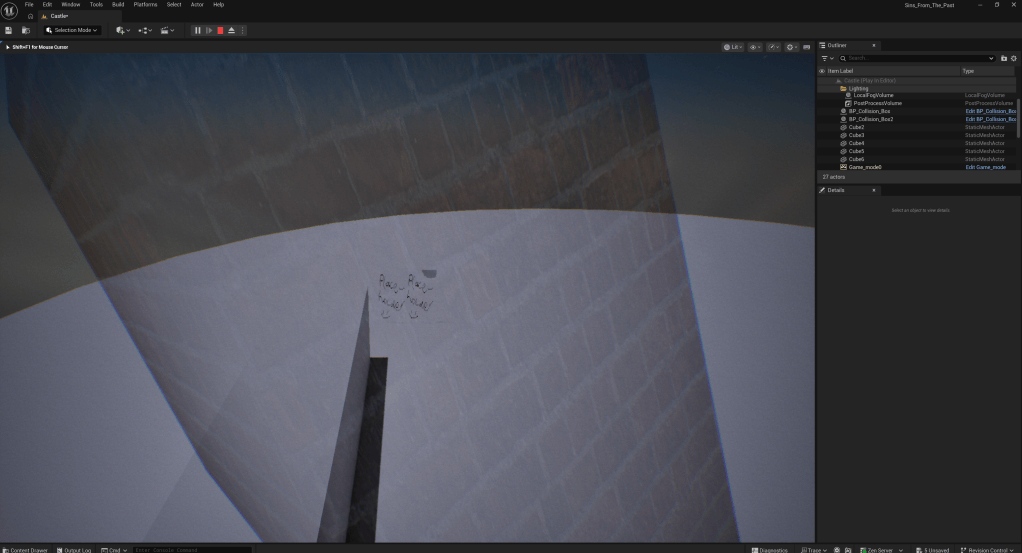
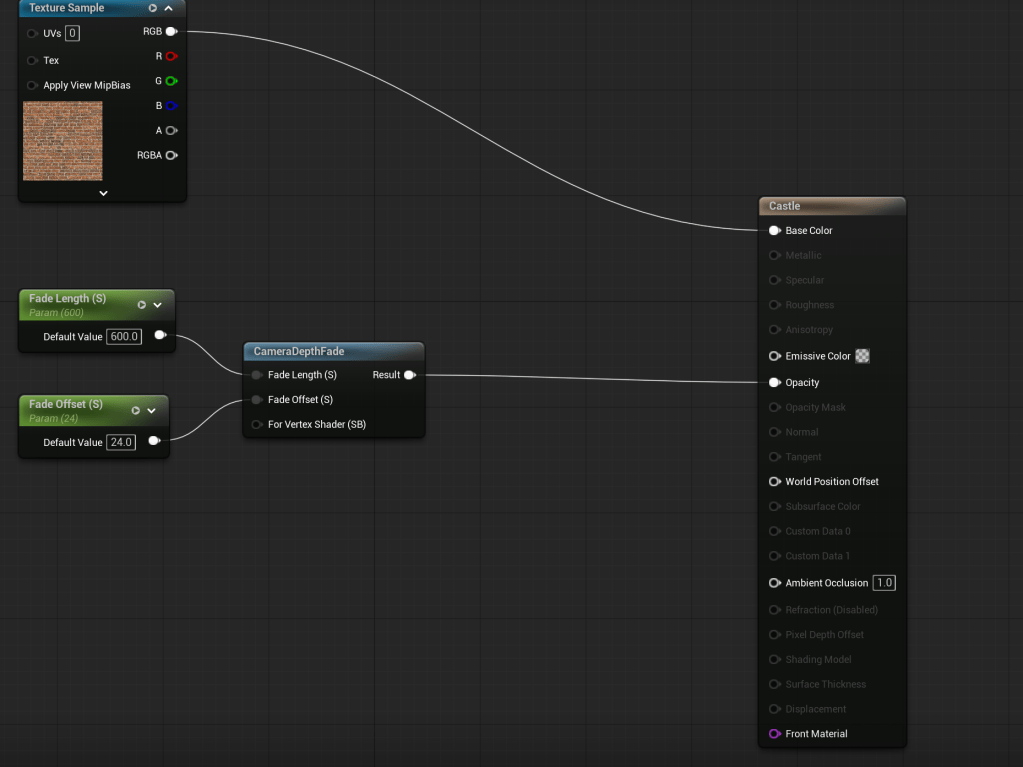
Messing around with the camera depth fade node in order to have transparent objects dependant on camera/player position.
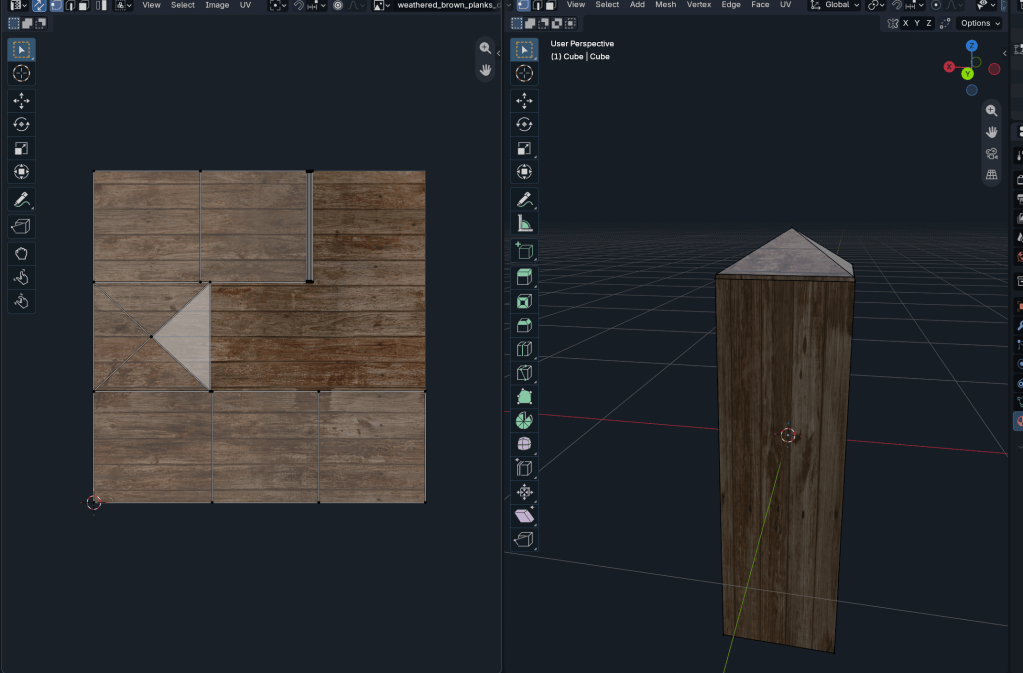
Beginning to create the first assets.
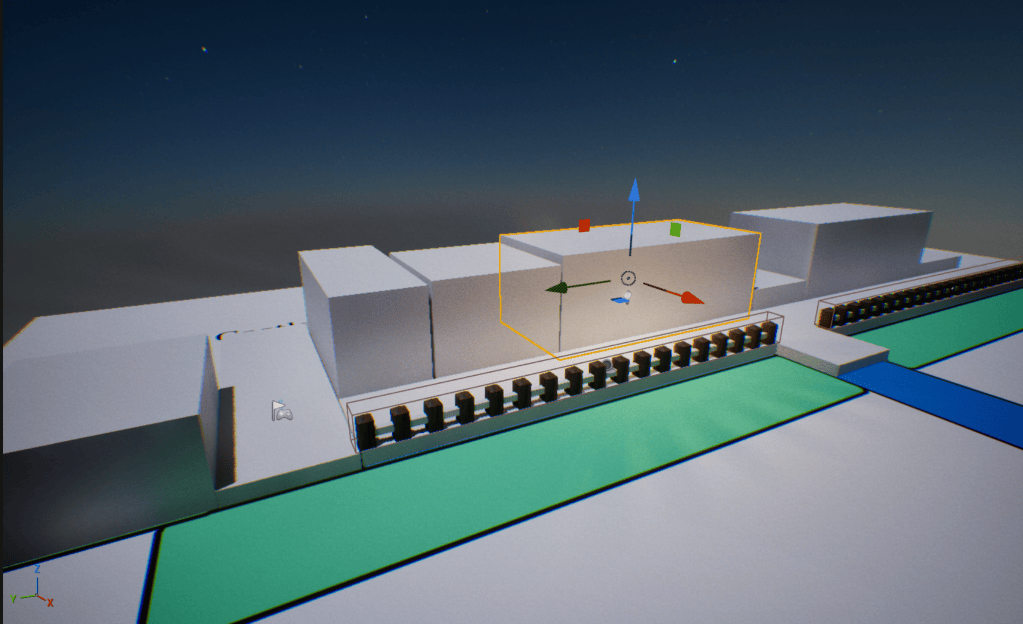
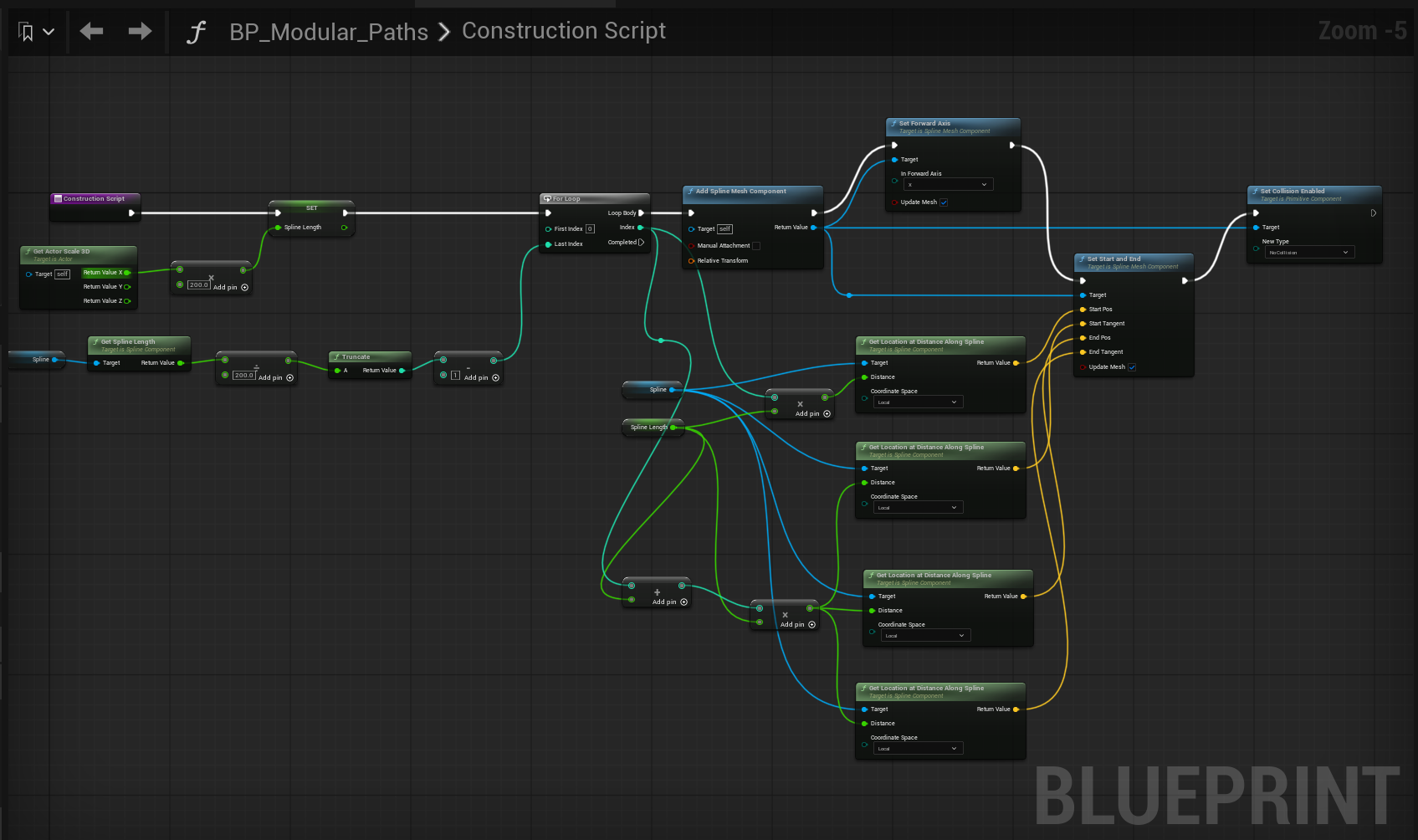
The construction graph for my modular paths.
As it turns out, I was unable to get this method to work. Instead, I am going to try placing my floor tiles individually.
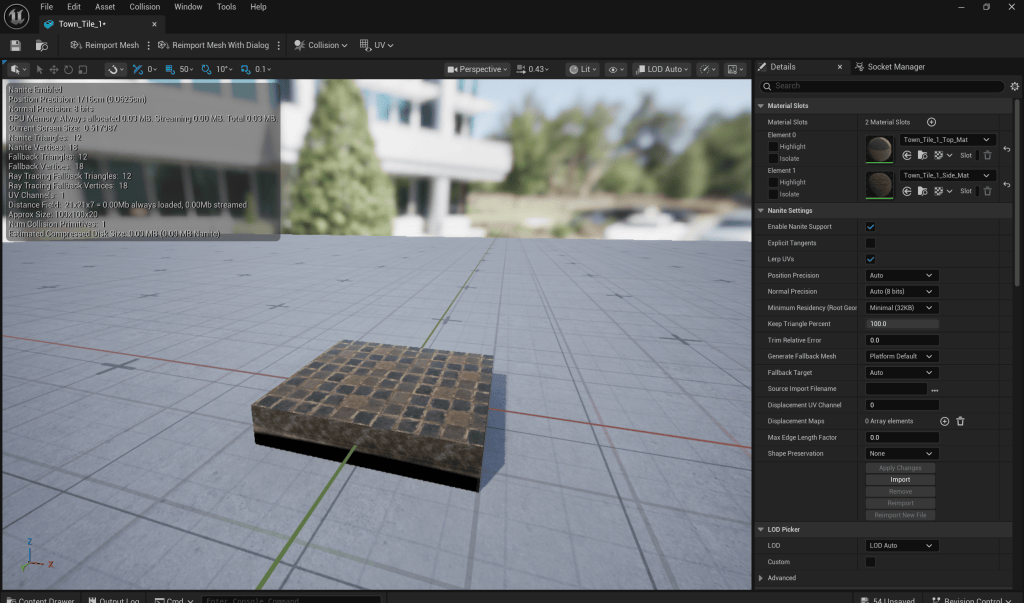
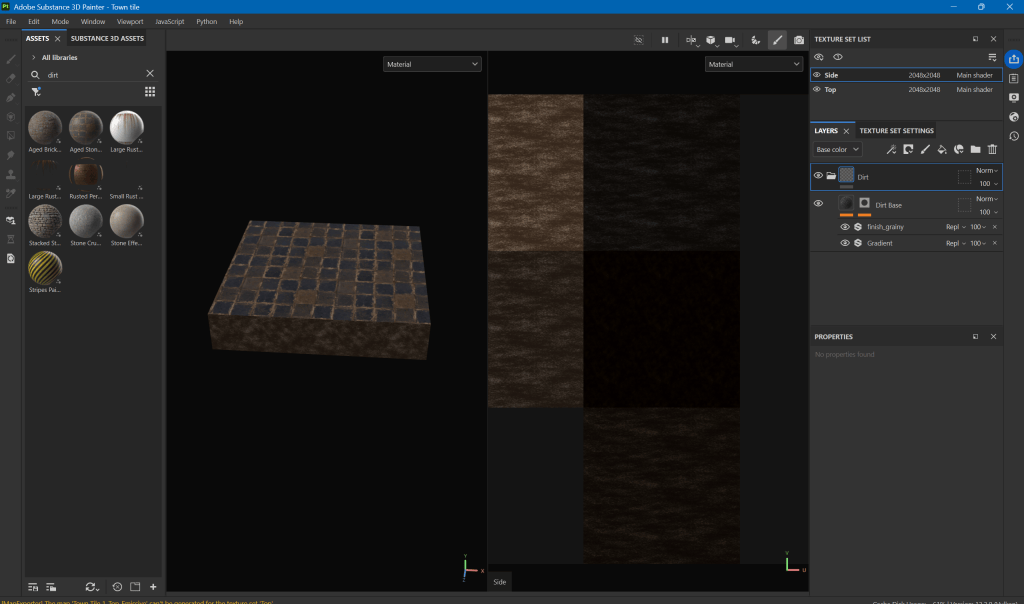
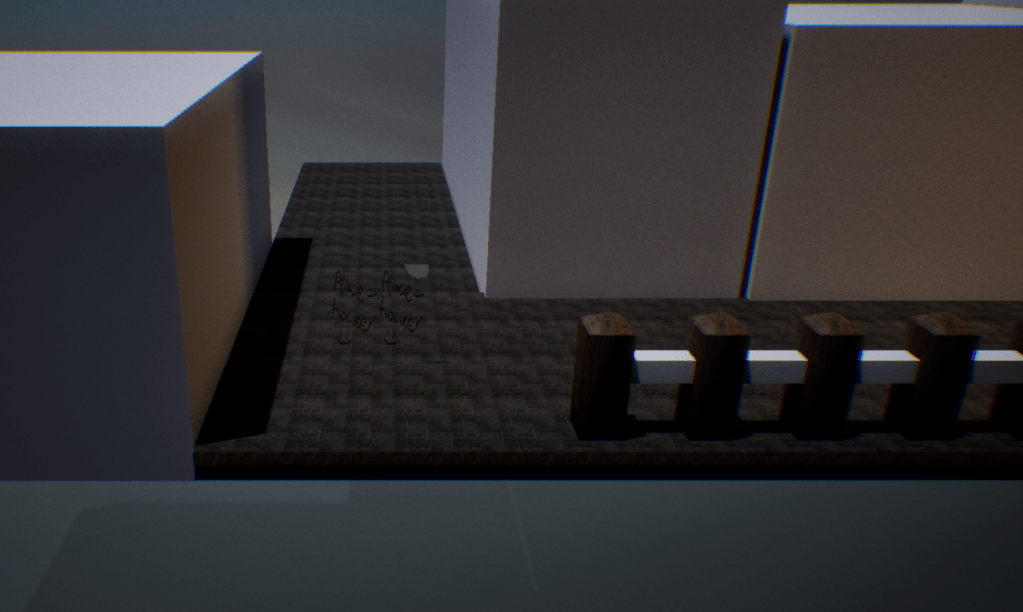
After changing the colour slightly, it looks okay. I will need to rotate the tiles to achieve a less repetitive effect.
After mucking around with a few different methods, I have come up with a practical solution.
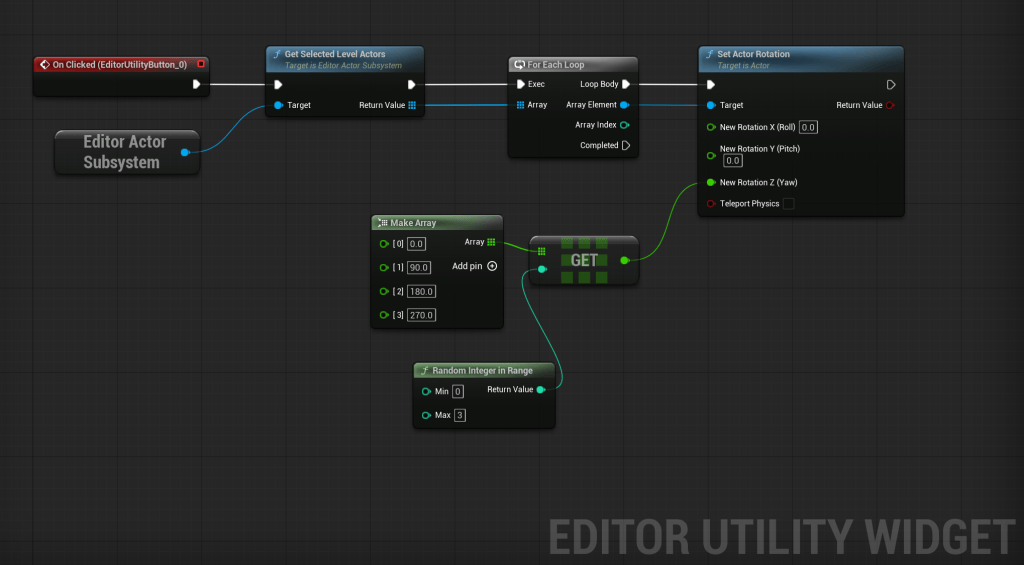
The code above randomly rotates my selected blocks to either 90°, 180°, 270° or not at all. All I need to do is manually select the tiles and let this blueprint do the work for me.
Unfortunately, this method did not work either due to the floor still looking tiled and inconsistent.
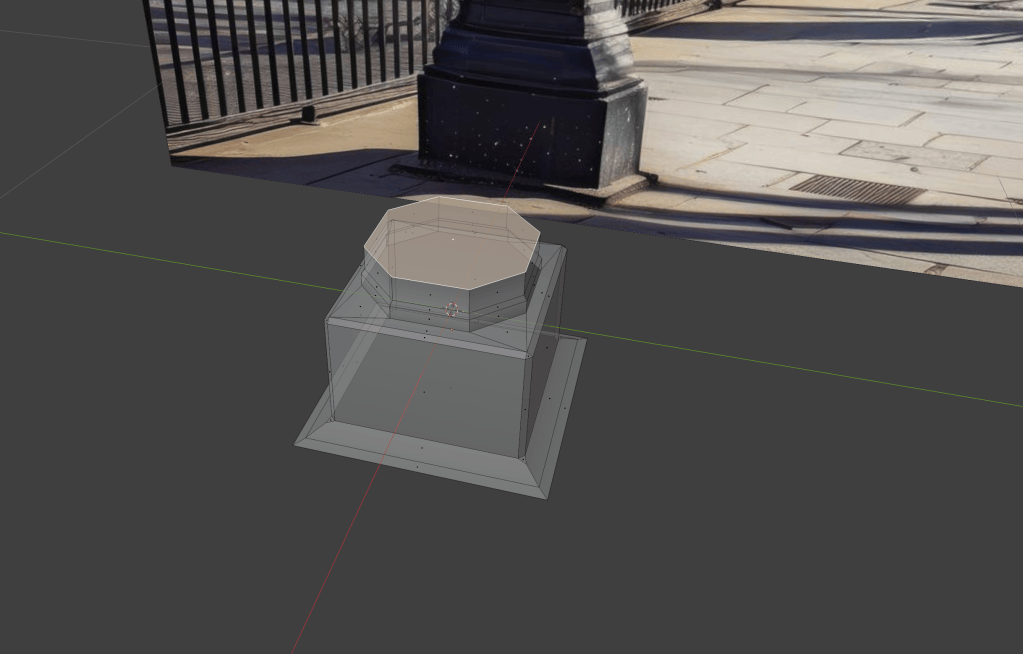
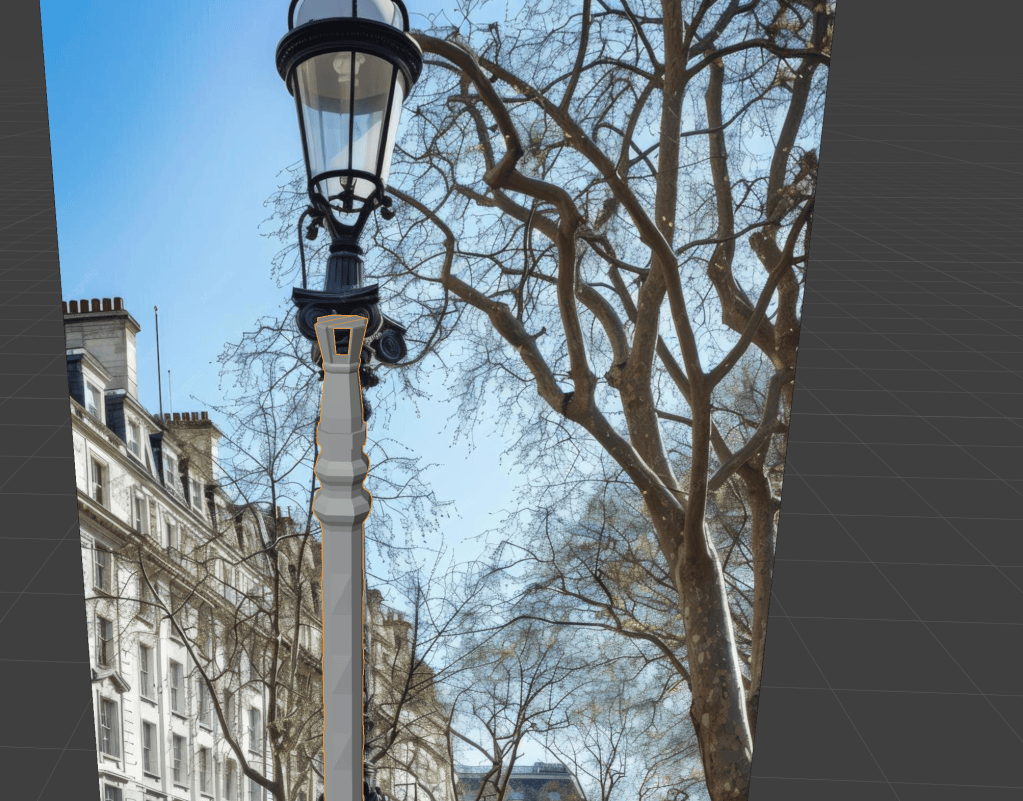
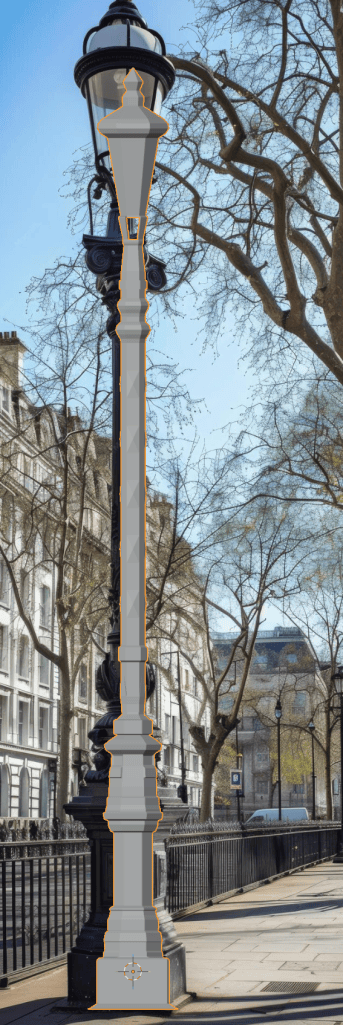
Beginning to design the street lamps.
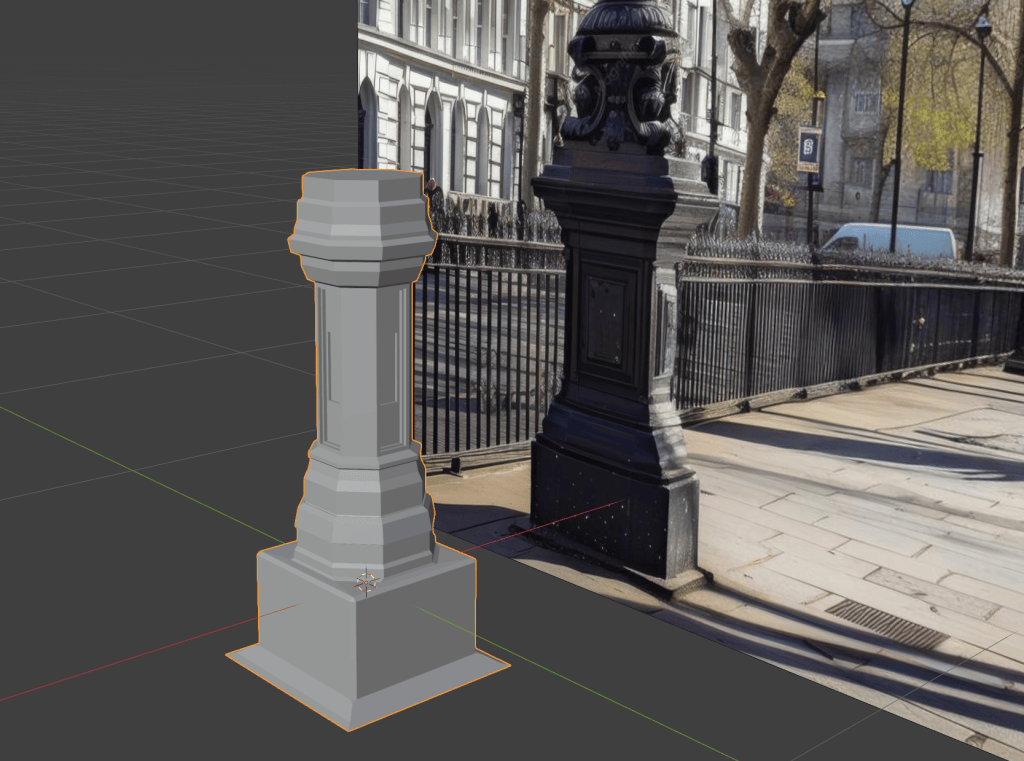
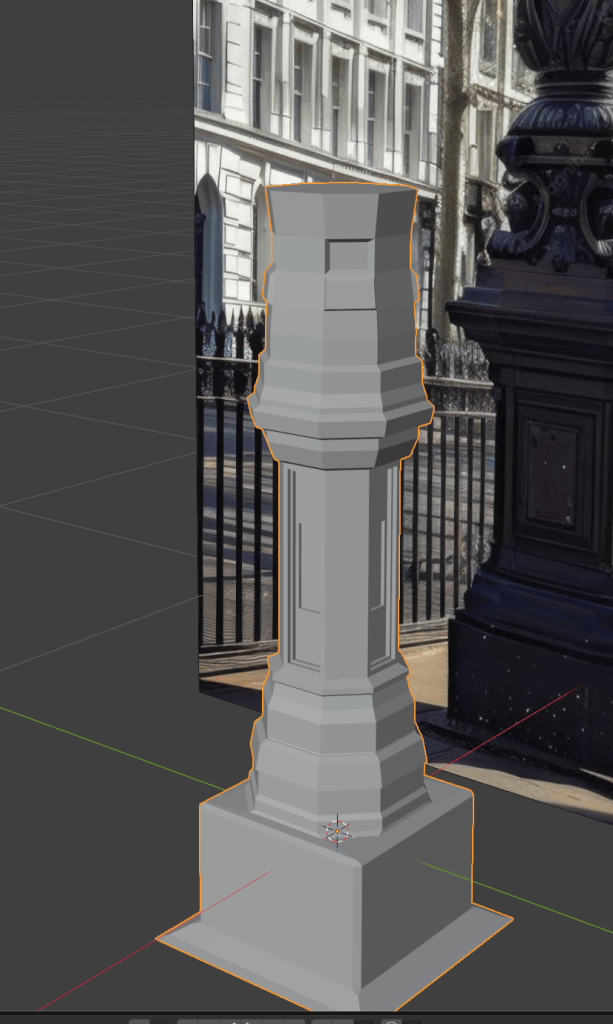
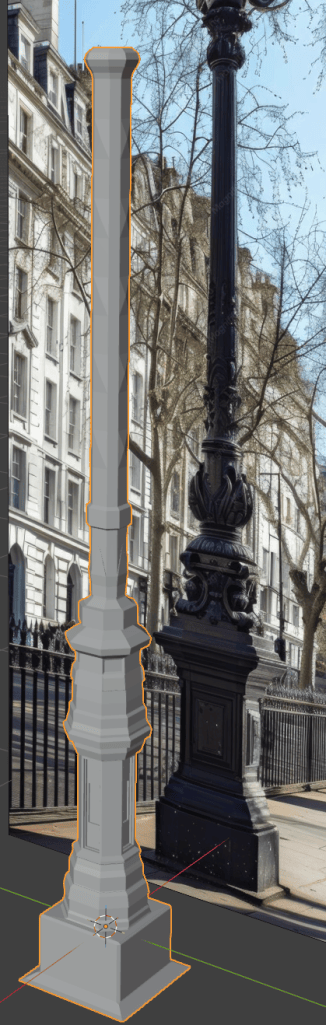
Production – The Dreamer (Player character)
I wanted to have a specific production log dedicated to the art of The Dreamer, who will function as the player character for my game.
This section will mostly detail the design side of things.
Feedback
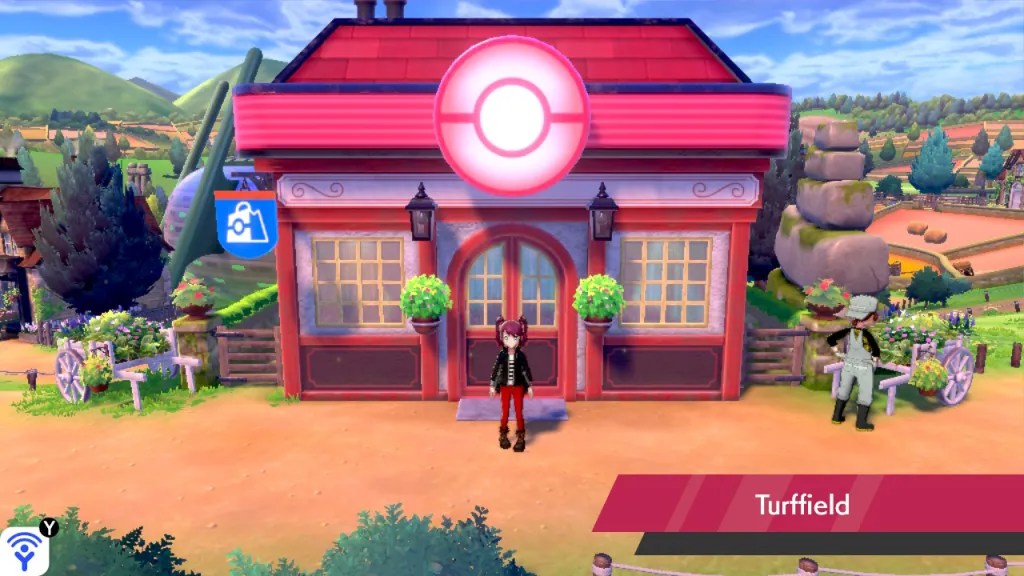
I have received feedback from a peer stating that my game reminds them of Pokémon Sword & Shield because of the camera angle.

